7-segment LED displays
7-segment LED displays – what you should know about them
In today’s digitized world, displays of various types play an important role. They transmit information to us, help us navigate, enable communication and provide indispensable data. Among these extraordinarily useful devices, 7-segment LED displays have a special place due to their simplicity, readability and broad applications.
- How a LED display is designed
- Method of displaying characters on 7-segment displays
- Displays with a greater number of segments
- Microcontrollers for controlling displays
In this article, we will discuss 7-segment LED displays in detail, take a look at their design, applications, method of control and significance in the modern world of electronics. From simple indicators to advanced devices, these small but versatile components play a critical role in our lives, helping us to understand and interpret information generated by devices in digital form. Get ready for a journey into the world of LED displays, and discover how they affect our everyday lives and develop along with technological progress.
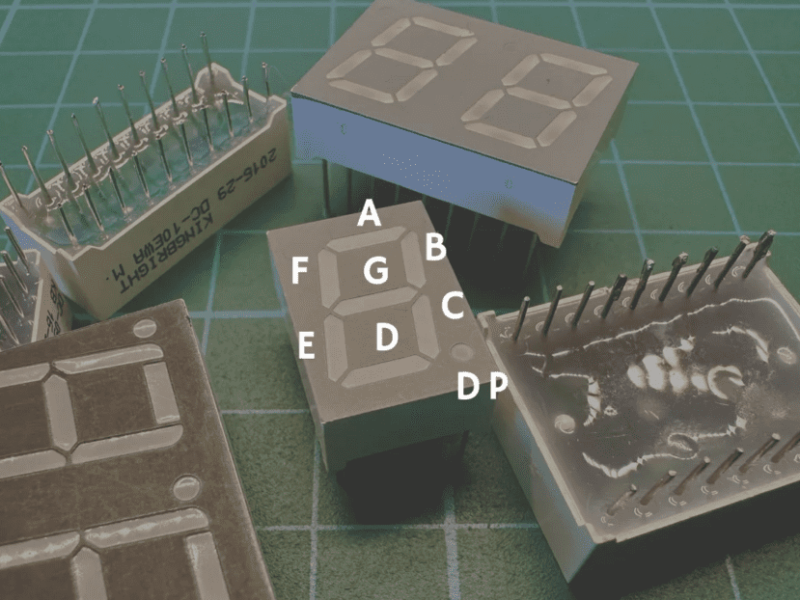
7-segment LED displays are an inseparable component of many electronic devices and ensure readable display of numbers, letter and alphanumeric characters. Their design is relatively simple, which makes them extraordinarily effective and reliable. 7-segment displays are based (as per their name) on seven segments, which are actually LEDs of a specific shape and color. Each of these segments is typically designated by a letter from “a” to “g”. These segments are arranged to form the shape of the number 8, with three horizontal segments (top, center and bottom) and four vertical segments forming the sides. A segment designated “dp” can typically also be found on the display and is interpreted as a period or comma.
 If you enjoyed this article, you will like the following ones: don't miss them by subscribing to :