A robot for remote embedded design
MikroE is developing a robotic system for its Planet Debug system to provide a fully automated development platform for embedded designs.
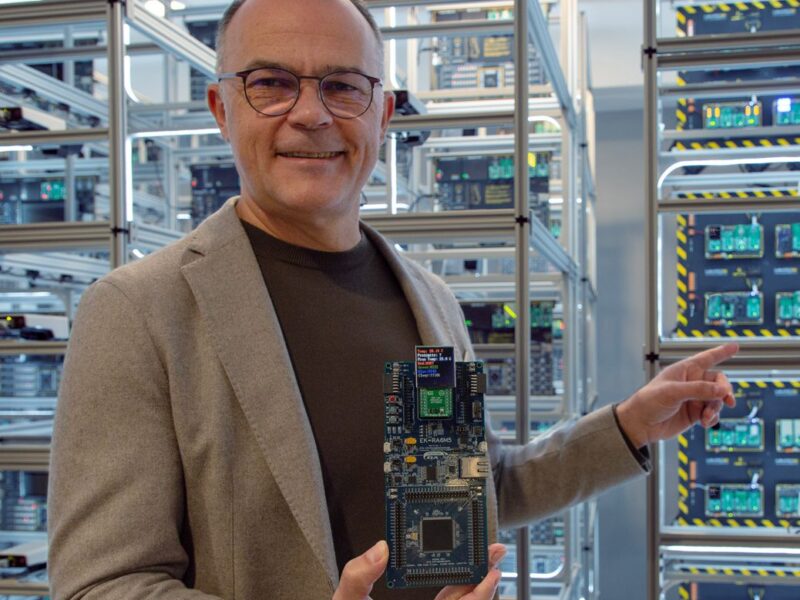
The MikroE Planet Debug system provides access to a development board with a choice of microcontroller with up to five Click boards to provide a choice of peripherals with access from anywhere in the world. Renesas is the first major semiconductor vendor to use the technology.
An in-house AI model in the NECTO integrated development environment (IDE) provides software libraries for the boards and code compilers for the microcontrollers, while the embedded Wiki builds custom projects directly from 1.7m projects.
The robotic system would swap out the click boards and central processors to allow developers to assess different combinations of peripherals. The NECTO development platform supports six architectures for microcontrollers through 12 compilers, while there are over 1900 Click boards in 255 categories that connect through the MikroBus.
“We are working on a robot that can place a click board on the board and create the code from the AI,” Neb Matic, CEO of MikroElektronika tells eeNews Europe. “This is something that is a really big time saver for engineers as it can suggest several combinations and the robot can place all three, then generate the code to see which fits the need best.”
MikroE CEO Neb Matic on AI code generation for embedded designs and a robot for Click boards
“For example, the AI combined five Click board projects and adds a TFT output and then generates the code – it’s not ChatGPT, it’s our model which we feed with the code we wrote,” he said. “If you feed the AI model with good code the output will be 99% accurate, so this example provides 300 lines autogenerated with no errors.”
Unlike other AI code software, the source code stays on the local machine. “We have local machines for training and we use AWS for the inference returning the code,” he said. The company started using AI in NECTO back in 2023.
The next step is expected to be a high level AI that can take a specification and define the clicks required then write the code and combine the libraries and test the various setups remotely in Planet Debug to determine the optimum implementation (see video). This would shorten the development time for an embedded project considerably.
The Renesas deal is a key step forward, he added.
“The whole idea is that I jumped on a plane and in less than a year we have a multiyear deal for development tools,” he said, “What made them decide to do the deal was approaching future customers to support 500 existing microcontrollers and to support every new one. That’s a big deal for us as it proves our approach.”
“They already have 39 boards with MikroBus and they saw the value of adding MikroBus to their boards and that is important recognition for what we are doing,” he said.
“That is proof that we can pull off real output from AI. That’s another reason why Renesas wants to have the boards
This system can also be used for in-house testing of boards and controllers. “This robot is not just for setting up, it can also work all night testing different things in NECTO for testing hardware and software combinations,” said Matic.
He expects the Renesas deal to expand from ARM-based microcontrollers to the proprietary architectures, “Our contract is to support 500 ARM-based microcontrollers but they will change their proprietary compiler to GNU (GCC) over time so they can give us more microcontrollers,” he said. “We know the roadmap for the next two years and it is important for us to have the silicon as soon as possible.”
 If you enjoyed this article, you will like the following ones: don't miss them by subscribing to :