A simulation model to counter the climate collapse
The new urban climate model PALM-4U will allow municipal staff and city planners to simulate the effects of their planned construction projects on the urban climate
Climate change poses challenges for us all, and city planners are no exception. Researchers expect the incidence of prolonged hot spells, heavy rain and storms to increase in the future. “Densely populated urban areas are particularly susceptible to these kinds of extreme weather events, and they do more than just affect people’s well-being. For individuals that are weaker or experiencing poor health, e.g., people in retirement homes, daycare centers and hospitals, extreme weather events can actually be dangerous,” explains Matthias Winkler, a hygrothermics expert at Fraunhofer IBP. This is why cities and municipalities are working intensively on planning construction initiatives that could help mitigate the consequences of climate change and make city climates manageable to a certain extent, thus maintaining and improving the quality of life in urban areas.
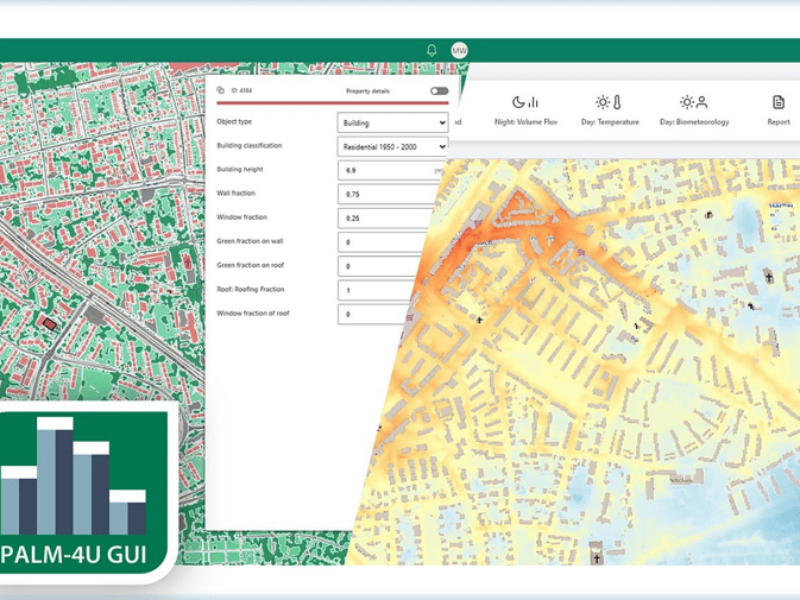
The PALM-4U urban climate model allows users to depict and simulate how construction projects impact the urban climate, which makes it a valuable resource for planning offices and municipalities. It could be used to simulate greening a facade or planting trees, for example, in order to find out whether these measures improve the citizens’ thermal comfort levels. The urban climate simulator also makes it possible to identify spaces that are particularly badly affected by high temperatures and to model the impact that construction projects such as installing green spaces or unsealing surfaces would have on the climate in the surrounding areas before implementing them. Mr. Winkler and his team made their contribution to the complex tool by developing the PALM-4U GUI, a user interface that has a straightforward, logical structure and allows users to configure all the necessary functions and parameters.
PALM-4U was designed and developed as part of the Urban Climate Under Change initiative by the German Federal Ministry of Education and Research (BMBF). “With PALM-4U, users can not only determine the impact that construction projects will have on the climate, but also quantify it precisely,” Mr. Winkler points out. This could also allow planners to assess whether investing in a particular building project would ultimately be profitable, or whether another initiative might have the same effect at a cheaper price.
The data basis for this tool is comprised of meteorological data from sources such as the German weather service (Deutscher Wetterdienst, DWD) and regional climate models. Municipalities can also incorporate weather data — such as temperature, humidity, wind speed and even the level of fine particulate matter in specific squares in the city — from any regional measurement stations they may have. In addition, the data basis will contain extensive geodata and city maps that show streets, squares, houses, bodies of water and green spaces. The more detailed and accurate the depiction of these elements is, the more reliable the PALM-4U simulation will be.
 If you enjoyed this article, you will like the following ones: don't miss them by subscribing to :