Adaptive SoCs claim highest AI performance per watt
The Versal AI Edge series, says the compamy, is designed to enable AI innovation from the edge to the endpoint, delivering AI-enabled intelligence for automotive, robotics, healthcare, and aerospace applications. Featuring 4x the AI performance-per-watt versus GPUs and 10x greater compute density versus previous-generation adaptive SoCs, the Versal AI Edge series is offered as the most scalable and adaptable portfolio for next-generation distributed intelligent systems.
“Edge computing applications require an architecture that can evolve to address new requirements and scenarios with a blend of flexible compute processing within tight thermal and latency constraints,” says Sumit Shah, senior director, Product Management and Marketing at Xilinx. “The Versal AI Edge series delivers these key attributes for a wide range of applications requiring greater intelligence, making it a critical addition to the Versal portfolio with devices that scale from intelligent edge sensors to CPU accelerators.”
Versal AI Edge adaptive compute acceleration platforms (ACAPs) are designed to deliver intelligence to a wide range of applications including: automated driving with the highest levels of functional safety, collaborative robotics, predictive factory and healthcare systems, and multi-mission payloads for the aerospace and defense markets. The portfolio features AI Engine-ML to deliver 4x machine learning compute compared to the previous AI Engine architecture and integrates new accelerator RAM with an enhanced memory hierarchy for evolving AI algorithms. These architectural innovations, says the company, deliver up to 4x AI performance-per-watt versus GPUs and lower latency resulting in far more capable devices at the edge.
Versal AI Edge devices are offered as delivering 10x compute density versus Zynq UltraScale+ MPSoCs, enabling more intelligent autonomous systems. Additionally, Versal AI Edge devices support multiple safety standards across industrial (IEC 61508), avionics (DO-254/178), and automotive (ISO 26262) markets, where vendors can meet ASIL C random hardware integrity and ASIL D systematic integrity levels.
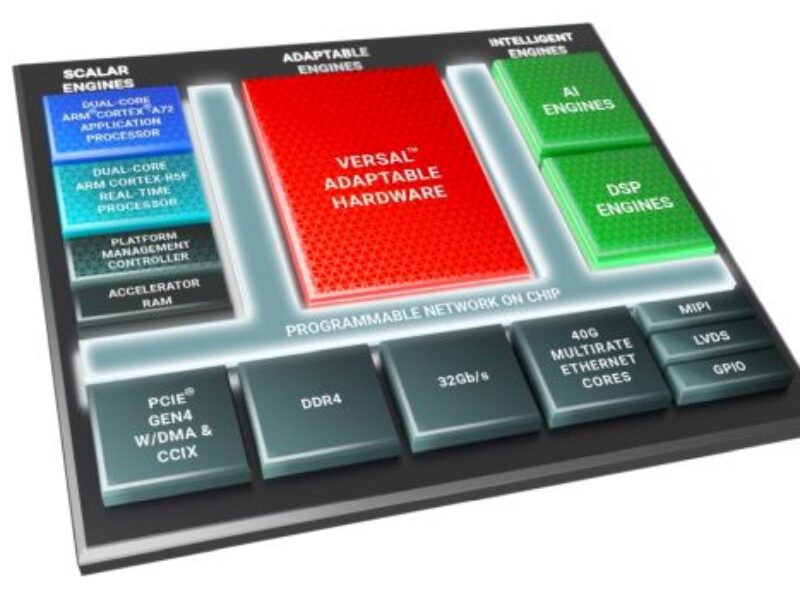
The Versal AI Edge series takes the production-proven 7-nm Versal architecture and miniaturizes it for AI compute at low latency, all with power efficiency as low as six watts and safety and security measures required in edge applications, says the compamy. As a heterogeneous platform with diverse processors, the Versal AI Edge series matches the engine to the algorithm, with Scalar Engines for embedded compute, Adaptable Engines for sensor fusion and hardware adaptability, and Intelligent Engines for AI inference that scales up to 479 (INT4) TOPS2 – unmatched by ASSPs and GPUs targeting edge applications – and for advanced signal processing workloads for vision, radar, LiDAR, and software defined radio.
Connectivity blocks range from LPDDR-4266, 32Gb/s transceivers to meet all the necessary protocols in edge applications, 40G multirate Ethernet, PCIe Gen4 with CCIX, and native MIPI support for vision sensors up to eight-megapixel resolution and beyond – critical to Level-2 ADAS and above. With more powerful AI Engines and an enhanced memory hierarchy that includes accelerator RAM, the Versal AI Edge series is offered as ideal for a wider range of applications across numerous markets.
Versal AI Edge ACAPs are offered as providing a design-entry point for any developer, including Vivado design tools for hardware developers, the Vitis unified software platform for software developers, Vitis AI for data scientists, and domain-specific operating systems, frameworks, and acceleration libraries for the platform’s target applications. Versal AI Edge series design documentation and support is available to early access customers, with shipments expected during the first half of 2022, and will include a roadmap for automotive- and defense-grade devices.
 If you enjoyed this article, you will like the following ones: don't miss them by subscribing to :