
AI and the hunt for signs of life beyond Earth
Researchers at the SETI Institute became the first to apply AI to the real-time direct detection of faint radio signals from space. Their advances in radio astronomy are available for any field that applies accelerated computing and AI
“We’re on the cusp of a fundamentally different way of analyzing streaming astronomical data, and the kinds of things we’ll be able to discover with it will be quite amazing,” said Andrew Siemion, Bernard M. Oliver Chair for SETI at the SETI Institute, a group formed in 1984 that now includes more than 120 scientists.
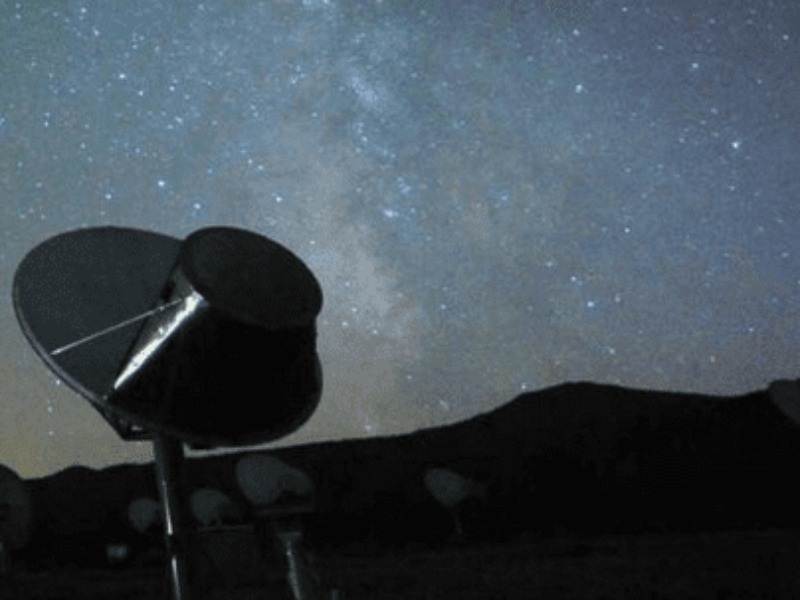
The SETI Institute operates the Allen Telescope Array (pictured above) in Northern California. It’s a cutting-edge telescope used in the search for extraterrestrial intelligence (SETI) as well as for the study of intriguing transient astronomical events such as fast radio bursts.
Germinating AI
The seed of the latest project was planted more than a decade ago. Siemion attended a talk at the University of California, Berkeley, about an early version of machine learning, a classifier that analyzed radio signals like the ones his team gathered from deep space.
“I was really impressed, and realized the ways SETI researchers detected signals at the time were rather naive,” said Siemion, who earned his Ph.D. in astrophysics at Berkeley.
The researchers started connecting with radio experts in conferences outside the field of astronomy. There, they met Adam Thompson, who leads a group of developers at NVIDIA.
“We explained our challenges searching the extremely wide bandwidth of signals from space at high data rates,” Siemion said.
SETI Institute researchers had been using NVIDIA GPUs for years to accelerate the algorithms that separate signals from background noise. Now they thought there was potential to do more.
A Demo Leads to a Pilot
It took time — in part due to the coronavirus pandemic — but earlier this year, Thompson showed Siemion’s team a new product, NVIDIA Holoscan, a sensor processing platform for processing real Ntime data from scientific instruments.
Siemion’s team decided to build a trial application with Holoscan on the NVIDIA IGX edge computing platform that, if successful, could radically change the way the SETI Institute worked.
The institute collaborates with Breakthrough Listen, another SETI research program, headquartered at the University of Oxford, that uses dozens of radio telescopes to collect and store mountains of data, later analyzed in separate processes using GPUs. Each telescope and analysis employs separate, custom-built programs.
“We wanted to create something that would really push our capabilities forward,” Siemion said. “We envisioned a streaming solution that in a more general way takes real-time data from telescopes and brings it directly into the GPUs to do AI inference on it.”
Pointing at the Stars
In a team effort, Luigi Cruz, a staff engineer at the SETI Institute, developed the real-time data reception and inference pipeline using the Holoscan SDK, while Peter Ma, a Breakthrough Listen collaborator, built and trained an AI model to detect fast radio bursts, one of many radio phenomena tracked by astronomers. Wael Farah, Allen Telescope Array project scientist, provided key contributions to the scientific aspects of the study.
They linked the combined real-time Holoscan pipeline, running on an NVIDIA IGX Orin platform, to 28 antennas pointed at the Crab Nebula. Over 15 hours, they gathered more than 90 billion data packets on signals across a spectrum of 5GHz.
Their system captured and analyzed in real time nearly the full 100Gbps of data from the experiment, twice the previous speed the astronomers had achieved. What’s more, they saw how the same code could be used with any telescope to detect all sorts of signals.
‘It’s Like a Magic Wand’
The test was “fantastically successful,” said Siemion. “It’s hard to overstate the transformative potential of Holoscan for radio astronomy because it’s like we’ve been given a magic wand to get all our data from telescopes into accelerated computers that are ideally suited for AI.”
 If you enjoyed this article, you will like the following ones: don't miss them by subscribing to :