Analog hardware solution for real-time compressed sensing recovery
A research team led by Prof. Sun Zhong at Peking University has reported an analog hardware solution for real-time compressed sensing recovery
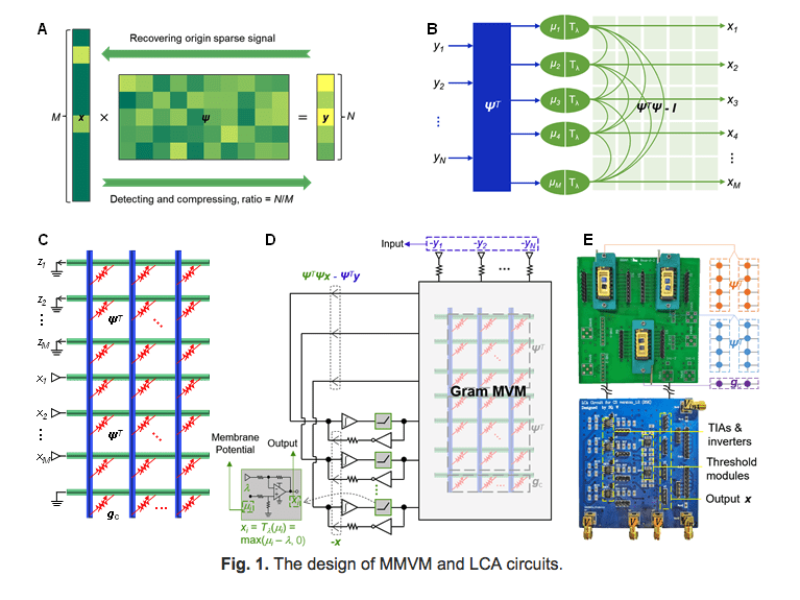
In this work, a design based on a resistive memory (also known as memristor) array for performing instantaneous matrix-matrix-vector multiplication (MMVM) is introduced. Based on this module, an analog matrix computing circuit that solves compressed sensing (CS) recovery in one step (within a few microseconds) is disclosed.
CS has been the cornerstone of modern signal and image processing, across many important fields such as medical imaging, wireless communications, object tracking, and single-pixel cameras. In CS, sparse signals can be highly undersampled in the front-end sensor, which breaks through the Nyquist rate and thus significantly improving sampling efficiency.
In the back-end processor, the original signals can be faithfully reconstructed by solving a sparse approximation problem. However, the CS recovery algorithm is usually very complicated and involves high-complexity matrix-matrix operations and pointwise nonlinear functions.
As a result, CS recovery in the back-end processor has become the accepted bottleneck in the CS pipeline, which prevents its application in high-speed, real-time signal processing scenarios.
To speed up the CS recovery computation, there have been two lines of efforts in the traditional digital domain, using either advanced algorithms (e.g., deep learning), or parallel processors (e.g., GPU, FPGA and ASIC). However, the computing efficiency is fundamentally limited by the polynomial complexity of matrix operations in digital processors.
 If you enjoyed this article, you will like the following ones: don't miss them by subscribing to :