Arduino VENTUNO Q brings Qualcomm IQ8 to edge AI
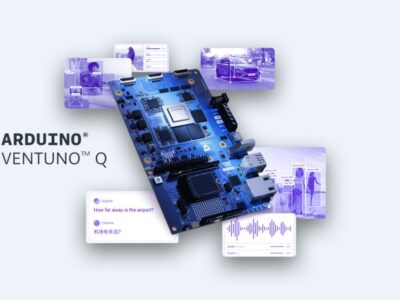
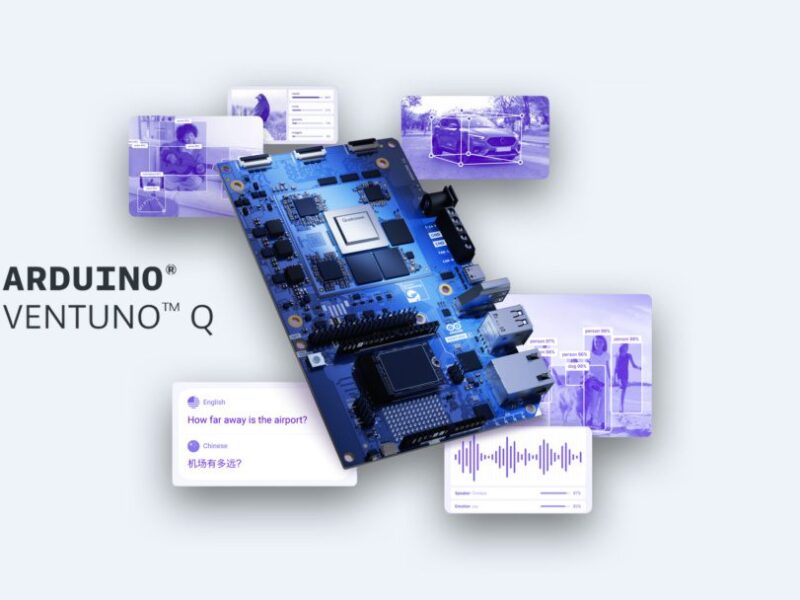
Arduino has used the eve of embedded world in Nuremberg to unveil the Arduino VENTUNO Q, a higher-end development platform aimed at what the company calls “physical AI”: systems that combine local inference with deterministic control for robotics, machine vision and industrial edge devices. The board pairs Qualcomm’s Dragonwing IQ8 Series with an STM32H5 microcontroller, extending the dual-brain idea first seen in the earlier UNO Q into a more capable format.
Arduino VENTUNO Q targets physical AI
On the AI side, Arduino says the board delivers up to 40 dense TOPS through the Dragonwing IQ8 platform, alongside 16 GB of RAM and 64 GB of storage. On the control side, the STM32H5 handles time-critical motor and actuator tasks, with the two domains linked so that perception, decision-making, and real-time response can run on one board rather than across a Linux SBC plus separate controller. The pitch is straightforward enough: fewer boxes, less integration pain, and a clearer route from prototype to deployable edge machine.
Arduino VENTUNO Q and the wider Qualcomm strategy
The launch also shows what Qualcomm wants from its October 2025 acquisition of Arduino. As previously reported by eeNews Europe when Qualcomm acquired Arduino, the deal was about more than hobbyist branding; it was a way to attach Qualcomm silicon and software to a very large developer base and push further into embedded AI, robotics and industrial IoT. VENTUNO Q is a more explicit expression of that strategy than UNO Q was, because it is aimed less at entry-level experimentation and more at systems that need cameras, audio, networking and motion control in the same design.
Arduino is also leaning on its software stack to lower the barrier. The company says VENTUNO Q works with Arduino App Lab across sketches, Python and ready-to-run AI models, with support for local LLMs, VLMs, speech recognition, gesture recognition and object tracking, plus integration with Edge Impulse Studio for custom model work. Linux Debian and Ubuntu support are part of the story on the main processor, while Zephyr underpins the real-time side. That will matter more than raw TOPS to many developers, because the real bottleneck in edge AI projects is often not inference silicon but getting heterogeneous software and control loops to behave.
Hardware support is pitched squarely at embedded developers rather than pure maker nostalgia. Arduino lists CAN-FD, PWM, high-speed GPIO, 2.5 Gb Ethernet, multiple MIPI-CSI camera connections, advanced audio support, and compatibility with UNO shields, Qwiic sensors, Modulino nodes and Raspberry Pi HATs. The board is due in Q2 2026 through the Arduino Store and distributors including DigiKey, Farnell, Mouser and RS. That timing places it neatly between this week’s trade-show reveal and Arduino Days 2026 later this month, when the company will also be celebrating its 21st anniversary.
 If you enjoyed this article, you will like the following ones: don't miss them by subscribing to :