ASUS IoT launches PE1000U for industrial edge AI
ASUS IoT has rolled out a compact, fanless industrial PC aimed squarely at edge AI workloads in robotics, machine vision, and autonomous mobile robots (AMRs). The new PE1000U combines Intel’s latest Core Ultra Series 2 processors with a rugged DIN-rail design built for harsh industrial and on-vehicle environments.
The announcement shows how edge compute platforms are shrinking while adding AI acceleration and richer I/O. It also highlights how PC-class processing is being adapted for space-constrained and vibration-prone deployments.
Edge performance in a small footprint
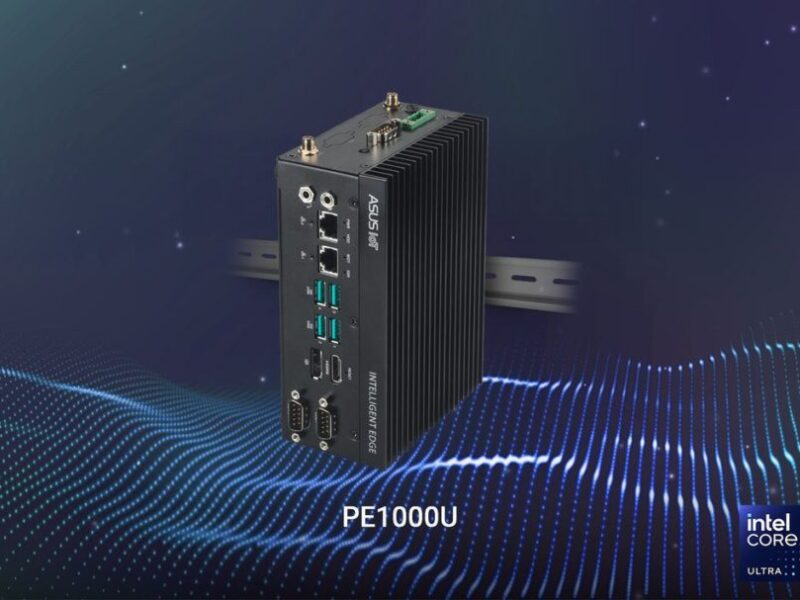
Measuring just 63 x 110 x 160mm, the PE1000U is designed to fit where traditional box PCs struggle. It is powered by either an Intel Core Ultra 265U or 235U processor, combining CPU, GPU, and NPU resources. ASUS positions this hybrid architecture as suitable for real-time motion control alongside AI inference and graphics processing.
The system offers front-access I/O, including four USB ports, up to four COM ports, and up to four Ethernet ports, with two 2.5GbE ports standard. Moreover, dual CAN Bus support and an isolated digital I/O module are aimed at deterministic industrial control tasks. For visualization and HMI, DisplayPort and HDMI outputs support up to two 4K displays.
The PC accepts a wide 9–36V DC input and includes built-in ignition control, making it suitable for vehicle-based systems. Operating temperature ranges from -25°C to 70°C, and the unit has been tested to US MIL-STD-810H standards for vibration up to 5Grms.
Fanless and built for the factory floor
A key design point of the PE1000U is its fully fanless thermal architecture. ASUS uses a wave-pattern aluminum heatsink that transfers heat directly from the CPU and memory to the outer chassis. With no fans or vents, the sealed IP40-rated enclosure helps keep out dust and contaminants while improving long-term reliability.
The company says this approach allows silent operation in demanding locations such as factory floors, semi-outdoor kiosks, and mobile platforms, even under continuous vibration or elevated ambient temperatures.
Focused on robotics and computer vision
ASUS IoT is clearly targeting robotics and vision-heavy applications. For AMRs, the small footprint, fanless design, and multiple LAN ports simplify integration with LiDAR, cameras, and fleet management systems. Optional WiFi 6E or 5G connectivity supports wireless backhaul.
For collaborative robots, the system benefits from vibration tolerance and screw-lock connectors. At the same time, the Intel Core Ultra processor provides the deterministic compute needed for real-time perception and motion planning. Meanwhile, in laser processing and industrial vision systems, the DIN-rail form factor and single-side I/O simplify cabinet wiring. In addition, multiple Ethernet ports support multi-camera configurations, while precise I/O triggering is achieved without introducing electrical noise.
 If you enjoyed this article, you will like the following ones: don't miss them by subscribing to :