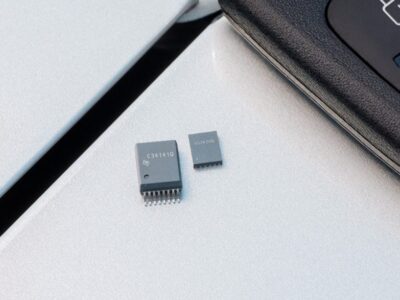

Automotive semiconductors for autonomous vehicles at TI
Automotive semiconductors for autonomous vehicles are a central focus of Texas Instruments’ latest automotive portfolio update. The company is expanding its range of compute, sensing and networking devices intended to support scalable ADAS and higher levels of vehicle autonomy.
For eeNews Europe readers working on ADAS, centralised compute architectures or zonal vehicle networks, the update provides insight into how one supplier is positioning its silicon to address functional safety, system integration and cost pressures across different vehicle classes.
Centralised compute and edge AI for ADAS
At the centre of the announcement is TI’s TDA5 family of high-performance automotive SoCs, designed to support centralised computing and sensor fusion tasks. According to the company, the devices scale from around 10 TOPS up to 1200 TOPS of edge AI performance, using a proprietary neural processing unit and a chiplet-ready design. TI positions the family as suitable for systems targeting up to SAE Level 3 autonomy, depending on configuration and vehicle architecture.
The company says the TDA5 devices integrate Arm Cortex-A720AE cores alongside safety and security features intended to support ASIL-D system designs. By consolidating ADAS, gateway and infotainment workloads on a single device, the approach is positioned as a way to potentially reduce system complexity and wiring while supporting cross-domain software integration.
To support software development, TI is also working with Synopsys on a Virtualizer-based development kit intended to help engineers simulate and validate software earlier in the design process.
Radar integration and in-vehicle networking
In sensing, TI introduced the AWR2188, an eight-by-eight 4D imaging radar transceiver that integrates eight transmit and eight receive channels on a single chip. The company argues that this level of integration could simplify high-resolution radar designs by avoiding the need for cascaded devices, while still supporting advanced use cases such as object separation and longer-range detection.
TI claims the device supports improved processing performance compared with earlier solutions, which could be relevant for applications such as cargo detection or complex urban scenarios, although real-world performance will depend on system design and software.
On the networking side, TI is adding a 10BASE-T1S Ethernet PHY, the DP83TD555J-Q1, aimed at extending Ethernet connectivity to vehicle edge nodes. The device is intended to support zonal architectures by enabling multi-drop Ethernet with time synchronisation and power delivery over a single twisted pair, potentially reducing wiring complexity in distributed vehicle systems.
Industry perspective
“The automotive industry is moving toward a future where driving doesn’t require hands on the wheel,” said Mark Ng, director of automotive systems at TI. “Semiconductors are at the heart of bringing this vision of safer, smarter and more autonomous driving experiences to every vehicle. From detection and communication to decision-making, engineers can use TI’s end-to-end system offering to innovate what’s next in automotive.”
The portfolio expansion reflects a broader industry trend toward scalable platforms that can be reused across multiple vehicle segments, balancing advanced functionality with cost and power constraints as autonomy features are rolled out incrementally. For European OEMs and Tier 1 suppliers, the focus on scalable automotive semiconductors for autonomous vehicles may help align cost, safety and software reuse requirements.
 If you enjoyed this article, you will like the following ones: don't miss them by subscribing to :