Automotive survey foresees ‘Car of the Future’
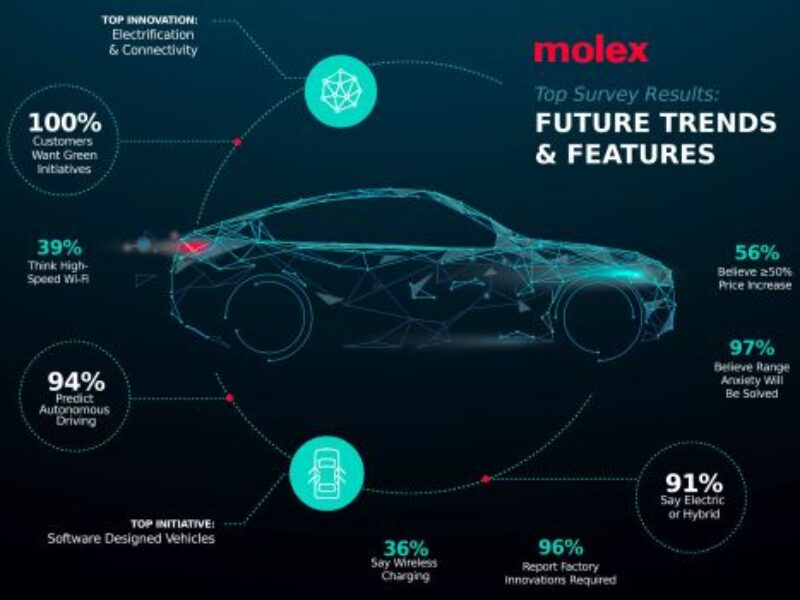
The findings of the survey of “the car of the future,” says the company, validate the critical role of data, software, and networking in enabling electrification and connectivity – identified as the two most important areas of innovation.
“It’s an exciting time in the automotive industry, and this survey underscores the accelerated pace of investment and innovation,” says Mike Bloomgren, SVP, president, Transportation & Industrial Solutions, Molex. “The results also reinforce our mission to design and deliver critical electronics solutions that form the central nervous system of tomorrow’s connected cars.”
The survey polled 230 qualified participants in engineering, product, procurement, R&D, supply chain, innovation, or strategy roles at automotive companies with at least 1,000 employees. Survey respondents were asked questions designed to help them visualize what an average new car purchased in 2030 might be like, including top features, initiatives and innovations.
Key findings include:
- 91% of respondents say cars will be either fully electric (64%) or hybrid (27%)
- 97% expect “range anxiety” to be solved by 2030
- 94% expect cars to include autonomous driving; only 28% envision fully self-driving cars
- 56% believe 2030 cars will be at least 50% more expensive than today’s cars
The top areas identified in the overall ecosystem with the most potential to reduce the price of a 2030 car were battery cost savings (40%), software integration (34%), and manufacturing processes (32%). In addition, 96% of the respondents agreed that the car of the future will require manufacturing factory innovations.
The top three features the respondents thought were most likely to be standard by 2030 are high-speed Wi-Fi, wireless charging, and car-to-car communication. In selecting the five most important innovation areas in the next decade, respondents picked electrification (38%), connectivity (33%), passenger safety (29%), quality and reliability (28%), and software-defined infrastructure (27%).
In addition, 60% of those polled favored the ability to deliver innovation via software as a priority, encompassing the intelligence needed for autonomous driving, advanced algorithms to reduce energy consumption, remote updates of new capabilities, and customized driving experiences. While 44% of survey respondents envision established automakers driving development of an average car purchased in 2030, 32% cited increasing traction by technology companies such as Apple, Google, and Microsoft.
Participants overwhelmingly reported major technology challenges to delivering innovation, with 44% citing insufficient battery life and 36% reporting obstacles getting electronics and software to operate in extreme scenarios. Additionally, 33% reported challenges in attaining hard-to-find expertise in electrification, 5G, security, and other needed technologies.
For more, see the report: “The Future of Automotive.”
Related articles:
Connected car market forecast sees over 14% CAGR to 2027
UL invests in self-healing software for connected cars
The car of the future: a personal butler
Connectivity solutions for emerging automotive platforms
Wi-Fi in the car: how to meet the concurrent needs of multiple systems and applications
 If you enjoyed this article, you will like the following ones: don't miss them by subscribing to :