Brushed DC motor driver ICs target ultra-low standby in appliances
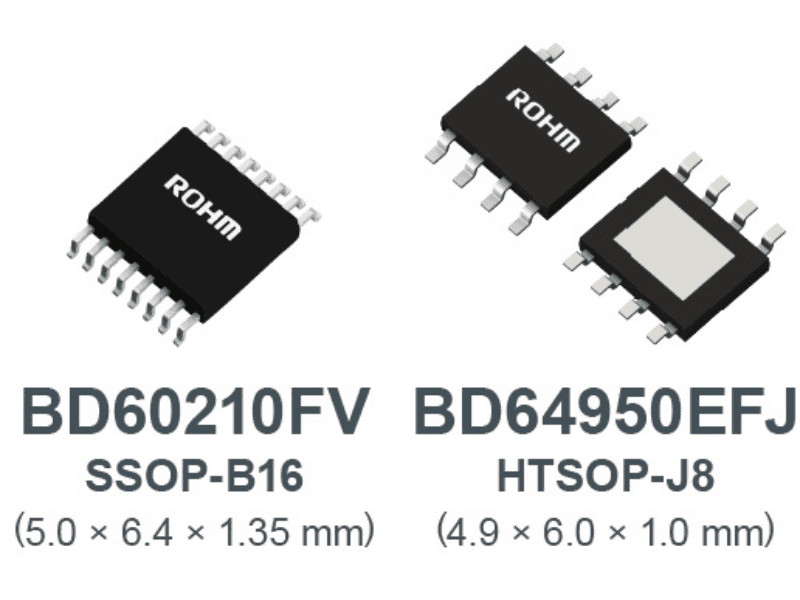
ROHM has rolled out two-brushed DC motor driver ICs aimed at brushed DC motors in home and office equipment, with the BD60210FV (20 V, 2-channel) and BD64950EFJ (40 V, 1-channel) now in mass production. The company is positioning the parts for appliances, including refrigerators, air conditioners, printers, and robotic vacuum cleaners.
For eeNews Europe readers, the announcement is relevant because brushed DC motor driver ICs control continues to appear in high-volume appliance subsystems, where standby consumption and PCB area can be important design considerations. It also highlights how white goods electrification is sustaining demand for flexible, reusable motor-drive building blocks.
Why ROHM is pushing flexibility and standby current
ROHM links the devices to broader electrification trends across consumer and industrial equipment, particularly in white goods, where designers are under pressure to reuse platforms across multiple product variants. At the same time, expectations around standby power are tightening.
The company highlights an ultra-low standby current specification of typically 0.0 µA and a maximum of 1.0 µA. At the system level, this could potentially support compliance with increasingly strict standby-power regulations, especially in always-connected appliances.
Two H-bridge options for different voltage and current ranges
The BD60210FV is positioned as a dual H-bridge device with direct PWM control. According to ROHM, it can drive two brushed DC motors, a bipolar stepper motor, or a solenoid. Its H-bridge architecture may allow some designs to avoid an external boost circuit, potentially reducing component count. The specified operating range is 8 V to 18 V, with 1 A per phase continuous current and up to 4 A peak.
The BD64950EFJ addresses higher-voltage and higher-current requirements with a single H-bridge supporting both direct PWM and constant-current PWM control. ROHM specifies a 40 V withstand voltage, 3.5 A continuous output, and 6 A peak current capability, aligning the device with 24 V-class brushed motor loads. Low on-resistance is intended to help limit heat dissipation in compact designs.
 If you enjoyed this article, you will like the following ones: don't miss them by subscribing to :