Dual-die stray-field robust 3D position sensor
TDK has launched a dual-die 3D Hall effect stray field sensor for automotive and industrial applications.
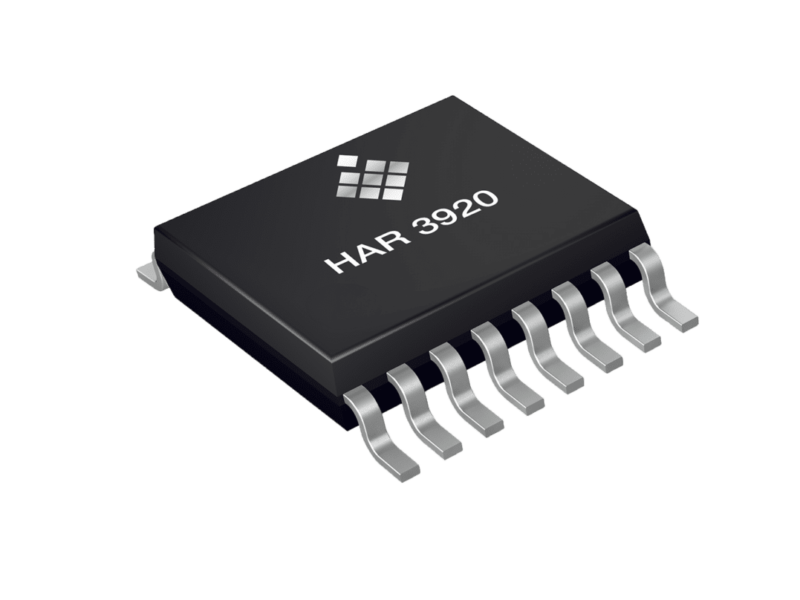
The Micronas HAR 3920-2100 is designed to be highly accurate for both linear and angular position measurements in the presence of disturbing magnetic stray fields with a measurement range from 10 mT up to max. 200 mT depending on measurement mode.
Developed in accordance with ISO 26262, the HAR 3920 meets ASIL C requirements, making it suitable for integration into automotive safety-related systems up to ASIL D for applications such as accelerator pedal position or throttle valve position measurement or as non-contact potentiometer.
- Hall effect position sensors for high-speed electric motor
- Hall effect position sensor with stray field compensation
The dual die of the HAR 3920 provide redundancy with two independent dies stacked in a single package, electrically connected to one side’s pins. This stacked-die architecture ensures consistent output signal characteristics by occupying the same magnetic-field position.
Using Hall technology, the sensor measures vertical and horizontal magnetic-field components, suppressing external magnetic stray-fields using an array of Hall plates. The sensor can measure a 360° angular range and linear movements of a magnet. A simple two-pole magnet is sufficient for precise rotation angle measurements, ideally placed above the sensitive area in an end-of-shaft configuration. The sensor also supports stray-field robust off-axis measurements.
A linear, ratiometric analog output signal with passive wire-break detection is compatible with pull-up or pull-down resistors and the HAR 3920 also has a switch output (open drain) derived from calculated position information or other sources along the devices signal path, allowing users to define on/off switching points, switch logic, and switch polarity.
On-chip signal processing calculates one angle per die from the magnetic-field components, converting this value into an analog output signal. Users can adjust major characteristics like gain, offset, and reference position by programming the non-volatile memory.
Designed for automotive and industrial applications, it operates in an ambient temperature range from –40 °C up to 160 °C, dependent on the supply voltage range. Compact and versatile, the sensor is available in the sixteen-pin SSOP16 SMD package.
The start of production is planned for April 2024; samples in an SSOP16 package are already available on request.
www.micronas.tdk.com/en/products/angle-sensors/hal-39xy.
 If you enjoyed this article, you will like the following ones: don't miss them by subscribing to :