Eatron, WMG team on battery Remaining Useful Life algorithm
Eatron Technologies and WMG at the University of Warwick have developed a way to estimate accurately an electric vehicle battery’s remaining useful life (RUL).
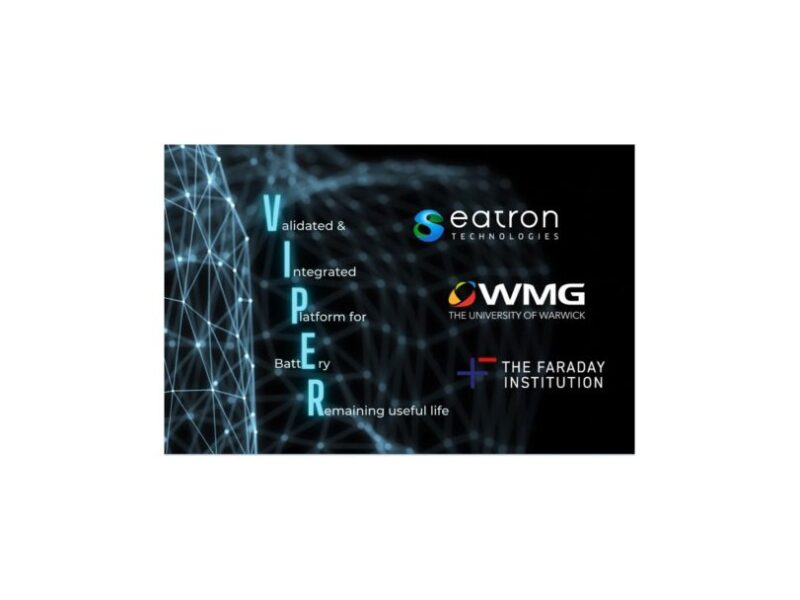
The VIPER (Validated & Integrated Platform for battery Remaining useful life) project combines WMG’s advanced electrochemical models with Eatron’s cloud battery management and integration expertise to deliver Remaining Useful Life (RUL) estimates that are more than 90% accurate.
The condition and performance of a battery changes as the cells within it age over time. If this natural degradation is not monitored closely, it can lead to cell failures with serious consequences. Traditional RUL estimates often rely on simple voltage-based analytics that may miss complex failure conditions, potentially risking the safety of consumers, while others that err on the side of caution may result in perfectly healthy battery packs being unnecessarily rendered unusable.
By accurately predicting a battery’s RUL, it becomes possible to extract the maximum performance and longevity from it, without compromising safety.
The algorithms developed by Eatron and WMG can be embedded in an automotive-grade battery management system (BMS) or deployed across a cloud-based platform, a concept that is particularly appealing for fleet applications.
In addition, when an automotive battery is eventually redeployed into its second life, it can be accompanied by an accurate picture of its health in the form of a battery passport that negates the need for expensive testing and increases the breadth of its operating window.
“Unlocking the hidden capacity of a battery has the potential to increase an EV’s usable range and extend its lifetime,” said Dr Umut Genc, CEO of Eatron. “There are benefits for the used EV market, too; as a result of these highly accurate RUL estimates, buyers could have confidence in the condition of a vehicle’s battery and be reassured about its ability to perform for many years to come.”
“The funding from the Faraday Institution has allowed us to bring the project forward by at least a year, and with innovative approaches such as this now in high demand, particularly among automotive OEMs, we’re delighted to be a part of bringing this technology to the market.” Dhammika Widanage, Associate Professor, WMG, University of Warwick
“Our support for UK-based efforts to develop cost-effective batteries that are efficient, fast charging, and can be safely and sustainably recycled is crucial to achieving the rapid growth in EVs on our roads that will see us deliver on our net-zero targets,” said Professor Pam Thomas, CEO, Faraday Institution. “The Eatron/WMG collaboration is a great example of the research and innovation elements of the Faraday Battery Challenge working together to deliver impact.”
 If you enjoyed this article, you will like the following ones: don't miss them by subscribing to :