
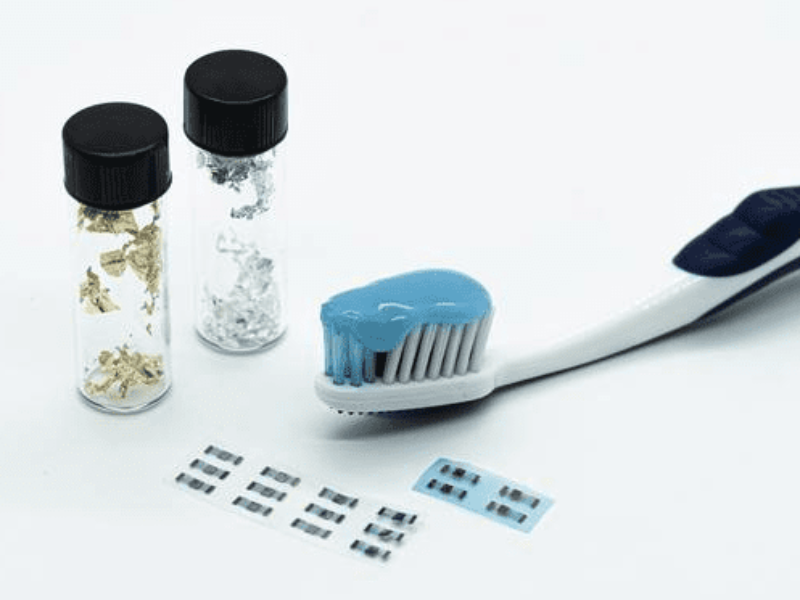
Edible toothpaste-based transistor
A toothpaste-based transistor has been developed which pushes the boundaries of edible electronics
From the HTWorld newschannel:
This edible transistor was developed in the Printed and Molecular Electronics laboratory led by Mario Caironi and follows the invention of an edible battery by the same group last year.
Several commercial toothpaste formulations contain crystals of copper phthalocyanine, a blue pigment that acts as a whitening agent. This substance is deposited on the teeth, functioning as an optical filter to enhance their whiteness.
Throughout the day, copper phthalocyanine is gradually removed by saliva and ingested.
The research team at IIT’s Center for Nano Science and Technology (CNST) in Milan (Italy) investigated the properties of this substance in collaboration with a dental researcher from the University of Novi Sad in Serbia.
Through laboratory simulations and analysis of existing clinical data, they determined that, on average, we inadvertently ingest about one milligramme of copper phthalocyanine each time we brush our teeth.
“With the amount of copper phthalocyanine we ingest daily, we could theoretically manufacture approximately 10,000 edible transistors,” says Elena Feltri, the paper’s lead author and a doctoral student at IIT’s CNST in Milan.
Actually, an intriguing aspect of this pigment is its chemical structure, which facilitates charge conduction within its crystals, making copper phthalocyanine an excellent candidate for use as a semiconductor in organic electronics applications.
The research team integrated small amounts of this new ingredient as a semiconductor into an already tested recipe for building edible circuits. The circuits are constructed on an ethylcellulose substrate, with electrical contacts printed using inkjet technology and a solution of gold particles, which are commonly used in culinary decoration.
A “gate” made from an electrolytic gel based on chitosan – a food-grade gelling agent derived from crustaceans like blue crabs – enables the transistor to operate at a low voltage of less than 1V.
 If you enjoyed this article, you will like the following ones: don't miss them by subscribing to :