Emerson introduces NI USRP X420 software-defined radio with 20 GHz range
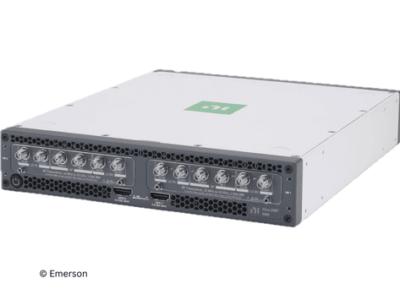
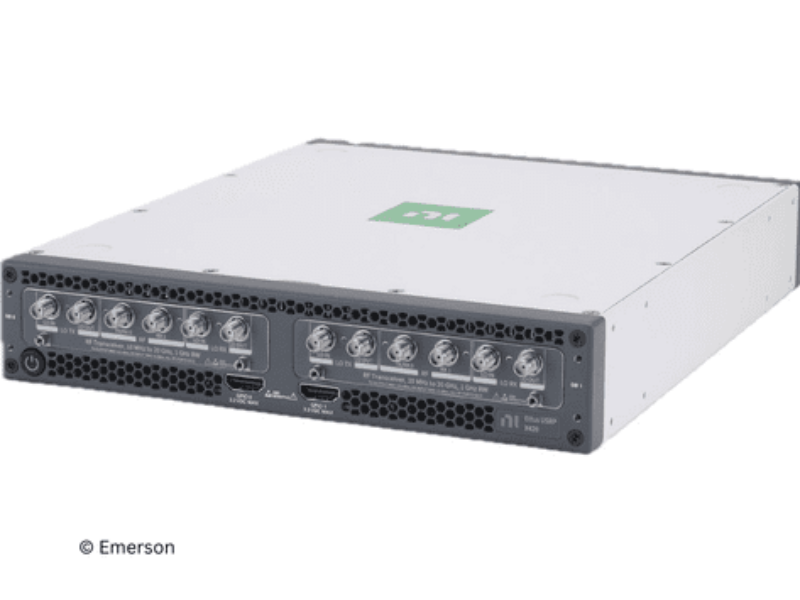
Emerson has introduced the NI USRP X420, a software-defined radio platform intended for radar development, satellite communications and emerging 6G research applications. The system expands the company’s Universal Software Radio Peripheral portfolio with higher frequency coverage and multi-channel capabilities aimed at advanced RF experimentation and prototyping.
For engineers and researchers working on next-generation wireless systems, access to flexible high-frequency test platforms is becoming increasingly important. The announcement could therefore be relevant to eeNews Europe readers involved in RF system design, satellite connectivity and early 6G experimentation.
RF platform aimed at advanced research applications
The NI USRP X420 extends Emerson’s software-defined radio range with frequency coverage up to 20 GHz, enabling access to higher spectrum bands including FR3 as well as Ku- and X-band frequencies. According to the company, these ranges are increasingly relevant for applications such as multi-channel radar systems, non-terrestrial networks and integrated sensing and communications.
The platform combines wide frequency coverage with high instantaneous bandwidth and a phase-coherent multi-channel architecture. This approach is intended to support the development and validation of complex RF systems in research laboratories, aerospace and defence environments, as well as in wireless communications research.
Such systems often require the ability to rapidly prototype and test algorithms or hardware configurations before moving to deployment. A flexible radio platform could potentially help engineers experiment with different signal processing architectures and RF configurations without redesigning hardware.
Phase-coherent architecture for radar and beamforming
One of the key architectural features is the ability to share a local oscillator across multiple channels. This LO-sharing capability allows phase-coherent operation, which is typically important for beamforming, MIMO radar and distributed sensing networks.
In multi-channel RF systems, synchronisation between radios can become complex. By integrating this capability directly into the software-defined radio platform, the X420 potentially reduces the need for external synchronisation hardware and simplifies system architecture.
The software-defined radio also offers large instantaneous bandwidth, allowing engineers to capture and generate wideband RF signals. This can support applications such as spectrum monitoring, record-and-playback analysis and integrated sensing and communications research.
“Researchers need tools that combine flexibility with performance to keep pace with rapidly evolving technologies like 6G and advanced radar,” said Sarah LaSelva, Chief Product Marketing Manager für NI RF and Wireless bei Emerson. “The X420 delivers that balance by providing access to high-frequency spectrum and multi-channel coherence in a software-defined platform that accelerates innovation.”
Emerson positions the device as its highest-performance RF platform within the NI USRP portfolio. The system is intended for academic researchers, government laboratories and commercial development teams exploring advanced wireless technologies.
As interest in high-frequency wireless systems grows, tools capable of supporting experimentation across radar, satellite links and potential 6G spectrum bands are likely to play an important role in early-stage development and validation.
 If you enjoyed this article, you will like the following ones: don't miss them by subscribing to :