
Engineering and matters of the heart
Professor Ellen Roche is creating the next generation of medical devices to help repair hearts, lungs, and other tissues
MIT news report:
“I worked on cardiovascular implants during my placement and loved it,” says Roche, an associate professor at MIT’s Institute for Medical Engineering and Science (IMES) and Department of Mechanical Engineering. “For me, early experience in the medical device industry was very influential because it showed me the elaborate process of what happens from the time a technology is designed at the bench, as it is developed into a meticulously tested and reliable device that will actually be implanted in a human.”
In graduate school, a similar program led Roche first to Mednova Ltd. in Galway and then to its sister company, Abbott Vascular in California, initially for a six-month stay. Roche enjoyed the work so much that she ended up staying three and a half years. While at Mednova and Abbott, she worked on a carotid artery filter designed to prevent stroke during the procedure when a stent is implanted. She also investigated coating parts of the stents with drugs that prevent arteries from becoming occluded.
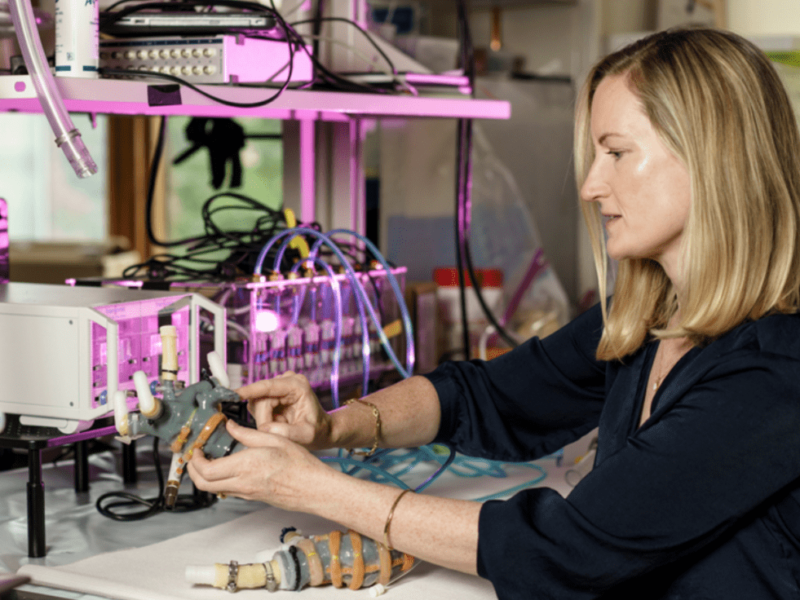
Roche, who earned tenure at MIT in July 2023, directs the Therapeutic Technology Design and Development Lab, which incorporates soft robotics, advanced fabrication methods, and computational analysis tools to develop novel devices that help to heal the heart, lungs, and other tissues. Some of the devices her team designs are intended for implantation into patients, such as a soft robotic ventilator, while others, such as a 3D-printed replica of a patient’s heart, enable research and testing of other therapies.
She encourages her students to find ways to collaborate and be flexible — and to get some kind of industry experience while still in school. She says she tells them, “Be open to accepting good opportunities as they arise, work with like-minded people, and work hard at what you are doing, but readapt when you need to.”
“There’s so much that’s very hard to even imagine until you spend some time in industry, including regulatory submissions, quality control, clinical studies, manufacturing considerations, sterilization, reliability, packaging, labeling, distribution, and sales. It really is a concerted effort of many teams with many skills to get a device to first-in-human studies,” Roche says. “Having said that, it’s one of the most rewarding.”
 If you enjoyed this article, you will like the following ones: don't miss them by subscribing to :