ESP32-E22 Wi-Fi 6E: Espressif’s first connectivity co-processor
Following their sneak peek at CES 2026, Espressif has formally introduced the ESP32-E22, pitching it as the company’s first tri-band Wi-Fi 6E connectivity co-processor and the start of a new high-performance wireless product line. In an announcement from its newsroom, the company says the ESP32-E22 is designed to act as a radio co-processor (RCP) that takes on the entire networking workload, leaving a host processor to focus on application code.
ESP32-E22 Wi-Fi 6E as a radio co-processor
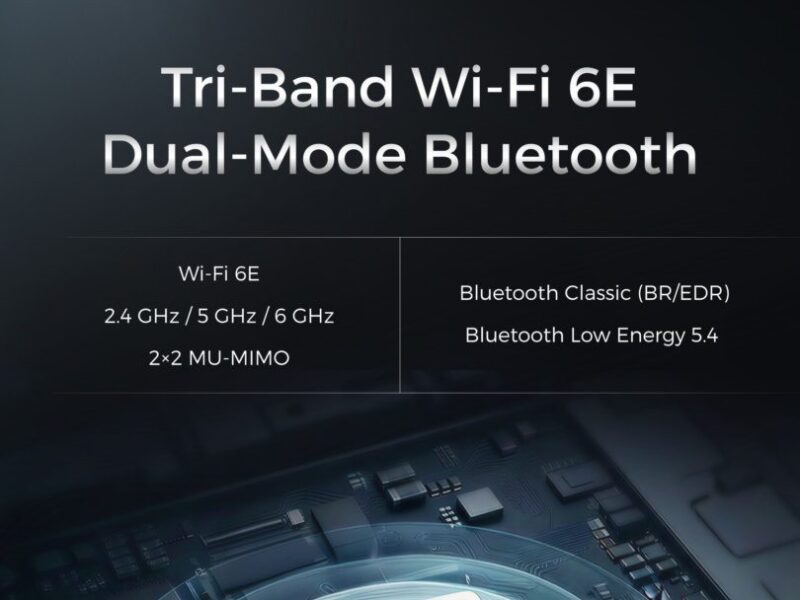
The core idea is offload. Espressif says ESP32-E22 Wi-Fi 6E runs the Wi-Fi and Bluetooth stacks internally (including security, authentication, scanning and roaming), and connects to a host over high-speed interfaces such as PCIe 2.1 and SDIO 3.0. The device integrates tri-band Wi-Fi across 2.4 GHz, 5 GHz and 6 GHz, alongside Bluetooth Classic (BR/EDR) and Bluetooth Low Energy 5.4, with coexistence intended to keep both radios usable at the same time.
What ESP32-E22 Wi-Fi 6E adds on the air interface
On Wi-Fi 6E, Espressif highlights 160 MHz channels, 2×2 MU-MIMO, beamforming and scheduling features aimed at higher throughput and lower latency in crowded RF environments. The company also says the part uses an in-house dual-core RISC-V design running at up to 500 MHz, and cites support for 1024-QAM and peak data rates up to 2.4 Gbps. Engineering samples are available now, but Espressif has not yet disclosed module options, pricing, or volume availability.
Context: from show-floor tease to product line
The ESP32-E22 Wi-Fi 6E name has been circulating since early January, with CES coverage pointing to Espressif working on a Wi-Fi 6E-capable co-processor; as previously reported by eeNews Europe when the company previewed the part alongside another low-power device, the positioning was already “connectivity offload” rather than “single-chip everything”. A third-party show report likewise described the device as a tri-band Wi-Fi 6E RCP with Bluetooth and high-speed host interfaces, ahead of this formal spec drop.
For product makers, the headline is simply more spectrum headroom and more flexible partitioning: keep your application CPU and OS choices open, but still ship tri-band Wi-Fi 6E plus Bluetooth in a single subsystem. As always with 6 GHz designs, actual channel availability and certification requirements are region-dependent, so the practical impact will hinge on where devices are sold and what RF front-end and antenna constraints look like in the final product.
 If you enjoyed this article, you will like the following ones: don't miss them by subscribing to :