Flexible test station with cobot combines AI, IoT
The Fraunhofer Institute for Mechatronic Systems Design IEM has combined a collaborative robot (cobot) with AI-based image analysis and an IoT platform.
An OWL supported collaboration with ATM producer Diebold Nixdorf and software specialist verlinked, the Fraunhofer IEM cobot system frees employees from having to perform visual inspections and can be incorporated into all kinds of testing scenarios.
Collaborative robots (cobots) are considered a key technology in industry. Generally equipped with AI and sensor technology, these robots work alongside people in production facilities, unlocking flexible and intelligent automation concepts. In today’s world of batch size 1, fragile supply chains, and new and ever-changing regulations, this is a crucial advantage over competitors.
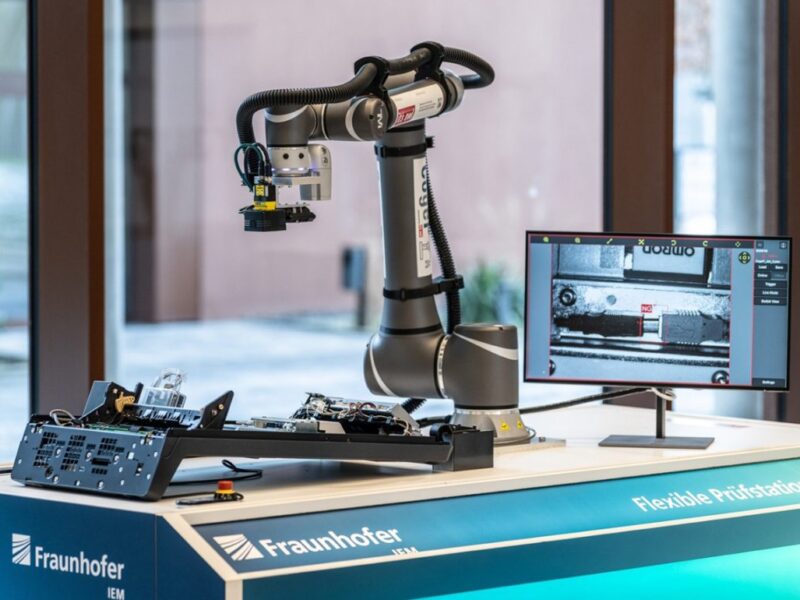
In partnership with Diebold Nixdorf and verlinked, the Fraunhofer researchers have developed a testing robot in the “it’s OWL” project called CogeP (Cobot-supported test stations for Intelligent Technical Systems). Employees use the robot to check the quality of ATM control panels quickly and without any errors — plus, it is easy to retool for an ever-changing range of testing tasks.
AI-supported quality checks
To check the control panels, the sensor-supported robot arm moves a camera over the components, workpieces or products to be analyzed from various angles. The AI-supported image analysis feature analyzes the quality, and then the robot moves the camera to the next product. If the analysis software finds any defects — a screw sticking out or a wobbly plug connection, for example — the system notifies the employees responsible, who can then zero in on the issue and correct it right away. This boosts productivity in production activities. Further, the employees also benefit from the cobot system. Dr.-Ing. Eugen Djakow, group manager for Automation Technology and Robotics at Fraunhofer IEM, comments: “Manual visual inspections in production are a monotonous, labor-intensive task for employees, and they’re error-prone on top of that. The testing robot handles these kinds of tasks quickly and reliably. And that makes people’s work in production more interesting and less monotonous, too.”
IoT platform for a testing scenarios
One highlight of the system is the way it combines the testing robot with an IoT platform. It functions as a real-time data center, assigning testing tasks, storing the results and collecting the corresponding data across different robots and assignments. This means testing processes can be further optimized. The data collected can also be used to adjust the testing for a new product version, without having to put a lot of time and effort into programming. New product versions only require minor tweaks to the testing procedure. “Cobot-supported test stations can collect all of the testing and operational data in the central IoT platform and access the information in real time. That means companies can reconfigure their testing routines to accommodate new requirements, without costly modifications or investments. In this way, the system offers total versatility as a tool for all kinds of testing scenarios,” Djakow adds.
Cobot workstations in production
The cobot system being presented can be used not only for testing processes but also for assembly, picking and packing, and general plant support. Fraunhofer IEM also harnesses its years of experience in industrial process technology and expertise in areas such as machine learning for automated pattern analysis to support SMEs in incorporating cobot workstations into existing production processes, all at low cost and without major investments in time and effort. This allows small and medium-sized enterprises, just like their larger counterparts, to modify their production operations on short notice or adapt to small unit volumes, right down to single items.
Image: The AI-powered image analysis software is integrated directly into the robot arm’s camera module. If the software detects a defect, the system will notify the employees, who can then rectify the fault. Copyright Fraunhofer IEM, Janosch Gruschczyk.
 If you enjoyed this article, you will like the following ones: don't miss them by subscribing to :