
Flying more climate-friendly with hybrid-electric drives
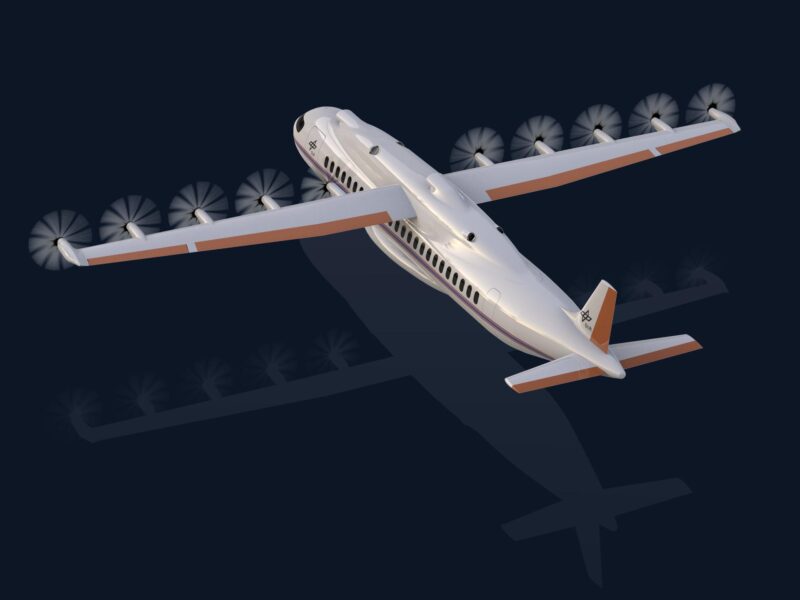
As part of the joint project SynergIE, scientists from the German Aerospace Center DLR, together with partners Airbus, Rolls-Royce and Bauhaus Luftfahrt e.V., have investigated the overall system of a hybrid-electric short-haul aircraft for up to 100 passengers with distributed drives on the wing. With this technology, the drives are distributed over the span of the entire wing and thus lead to a more efficient flow around the aircraft.
“In classic regional aircraft, the wings are often oversized in order to achieve good take-off and landing performance,” explains Dr Martin Hepperle from the DLR Institute of Aerodynamics and Flow Technology. “These aircraft then fly at too high an energy consumption in cruise flight.” Highly accurate flow simulations showed that electric drives allow the thrust to be distributed over many smaller propellers. When these then overflow the wing, they provide increased lift and more efficient aerodynamics. This effect allowed the project partners to reduce the wing area and wing mass, and to reduce drag through the interaction of the propeller jets with the wing’s edge vortices.
As a final design for an aircraft with distributed hybrid-electric drives, the researchers selected and evaluated a concept with turbo generators in the fuselage and ten electric motors along the leading edge of the wing as the best solution from a number of different approaches. By optimally designing and installing the propellers, it is possible to reduce the wing depth and rudder size and thus reduce energy consumption by about 10%. “The special arrangement of the propellers allowed us to compensate for the weight disadvantages of the hybrid-electric propulsion system,” says Hepperle. “We were also able to design the vertical stabiliser smaller and thus lighter and with less drag in our multi-engine concept,” Hepperle continues. “This concept can even compensate for the failure of two electric motors, so it also offers greater operational reliability.”
During the – initially only virtual – maiden flight in DLR’s AVES flight simulator, DLR test pilots evaluated the flight characteristics of the hybrid-electric short-haul aircraft. Particularly during the landing approach, it became apparent that the aerodynamic interaction of the propeller wake and wing strongly influences the flight characteristics of the aircraft. To compensate for the reduced effectiveness of the smaller rudder and tail, a research team from the DLR Institute of Flight Systems Engineering developed a flight control controller that enables yaw control – control around the vertical axis – using rudder and differential thrust.
As part of the project, the participants have developed and established an end-to-end “software simulation tool chain” for future aircraft designs with distributed hybrid-electric drives at DLR. The cross-disciplinary work content includes the integrated aerodynamics of the wing and propeller in close interaction with flight mechanics issues for control as well as boundary conditions of the structure and aeroelasticity. In the future, open questions on the aeroacoustics of the distributed propellers and on optimal flap systems in the landing approach are to be clarified.
On the way to climate-compatible air transport, the DLR researchers still see a considerable need for research and development, which requires continuous funding and support. Much of this needs to be researched in the basics, tested in practice and approved. DLR can do this with large-scale facilities such as its research aircraft, propulsion demonstrators and mainframe computers. In 2020, DLR published the white paper “Zero Emission Aviation” together with the BDLI. DLR is currently working on a zero-emission strategy.
The SynergIE project was funded by the German Federal Ministry for Economic Affairs and Energy (BMWi).
https://www.dlr.de/EN/Home/home_node.html
Related articles:
Personal air vehicle for the masses
eVTOL flying car targets consumers
Air taxi startup raises $240 millions
Autonomous air taxi trial slated for New Zealand
Air taxi startup raises $240 millions
Lillium e-plane completes maiden flight
 If you enjoyed this article, you will like the following ones: don't miss them by subscribing to :