Hybrid photonic-terahertz chip for communications and sensing
 Cette publication existe aussi en Français
Researchers at EPFL and Harvard University have engineered a hybrid photonic-terahertz chip that can convert between electromagnetic pulses in the terahertz and optical ranges on the same device.
Terahertz waves on the electromagnetic spectrum have frequencies higher than microwaves used in telecommunications technologies like Wi-Fi but lower than infrared light used in lasers and fibre optics. Their short wavelengths enable large amounts of data to be transmitted very fast, but connecting THz radiation to existing optical and microwave technologies has been extremely challenging.
In 2023, researchers in the Laboratory of Hybrid Photonics came one step closer to bridging this gap when they created an extremely thin photonic chip made of lithium niobate that, when connected to a laser beam, produced finely tailorable THz waves. Now, the team has reported a novel design that not only generates THz waves but also detects incoming ones by converting them to optical signals.
This bi-directional conversion on a single, miniaturised platform is an essential step toward bridging the THz and optical domains. It could enable the development of compact and power-efficient devices for communication, sensing, spectroscopy and computing.
“In addition to demonstrating the first detection of THz pulses on a lithium niobate photonic circuit chip, we generated THz electric fields over 100 times stronger and increased the bandwidth by a factor of five (going from 680 GHz to 3.5 THz),” says Cristina Benea-Chelmus, head of the Laboratory of Hybrid Photonics.
Terahertz radar to 6G communications
According to PhD student and first author Yazan Lampert, the innovative design centres on embedding micron-sized structures called transmission lines into their lithium niobate photonic chip. These lines act like chip-scale radio cables to guide THz waves along the chip. By placing a second structure nearby to guide optical (light) waves, the scientists enhanced interaction and conversion between the two with minimal energy loss.
“We can control both optical and THz pulses on the same platform simply through our miniaturised circuit design. Our approach combines photonic circuits and THz circuits on a single device with unprecedented bandwidth,” Lampert says.
The broadband THz signals generated by the hybrid device could, for example, be used to develop terahertz-based radar, in which extremely short THz pulses could be used to estimate an object’s distance (ranging) within one millimetre. Thanks to its compact and energy-efficient design, the chip is also compatible with existing photonic technologies like lasers, light modulators, and detectors. The team is already working on fully miniaturising the chip design to enable seamless integration into the next generation of communications and ranging systems, such as those used in self-driving cars.
Amirhassan Shams-Ansari, the co-first author of this work and currently a Principal Laser Engineer at DRS Daylight Solutions (formerly a postdoctoral researcher at Harvard University), remarks: “Thin-film lithium niobate has proven to be a powerful platform for integrated photonics, enabling a new generation of applications and devices. It is truly exciting to see this technology advancing into the highly promising yet underexplored THz domain.”
“We anticipate that the design guidelines we propose will become crucial in future terahertz applications such as high-speed 6G communications, where sensing and ranging will be an essential component of the communication network,” Benea-Chelmus says.
The research has received funding from the European Union (MIRAQLS Grant No 101070700), Swiss National Science Foundation (PRIMA Grant No 201547), and the SNSF-NSF Lead agency program (NSF ECCS-2407727).
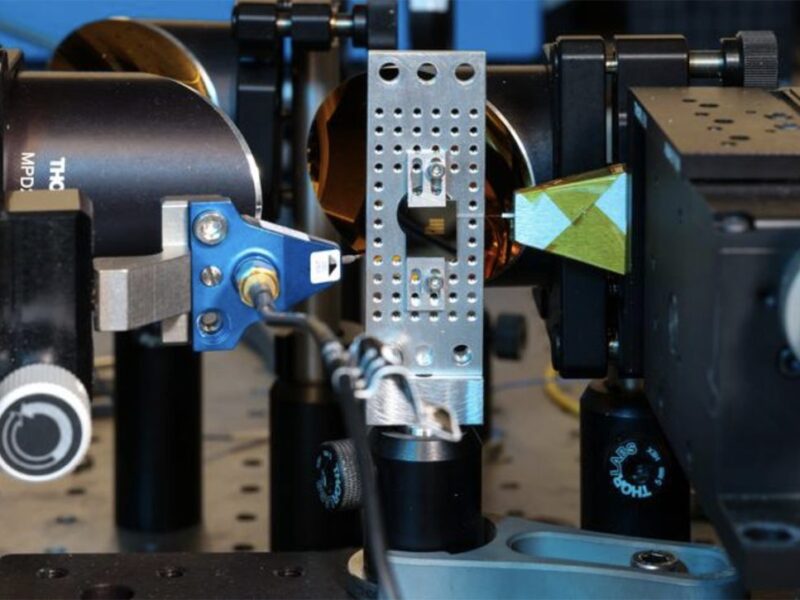
Image: Photonic and terahertz circuits integrated and tested on a single chip. The generated terahertz radiation is collected by the gold mirror in the back to be used for spectroscopy (or sensing) of different materials. Credit: 2025 EPFL/Alain Herzog CC BY SA 4.0.
The research paper was published in Nature Communications. DOI: https://doi.org/10.1103/m1hl-d18s
 If you enjoyed this article, you will like the following ones: don't miss them by subscribing to :