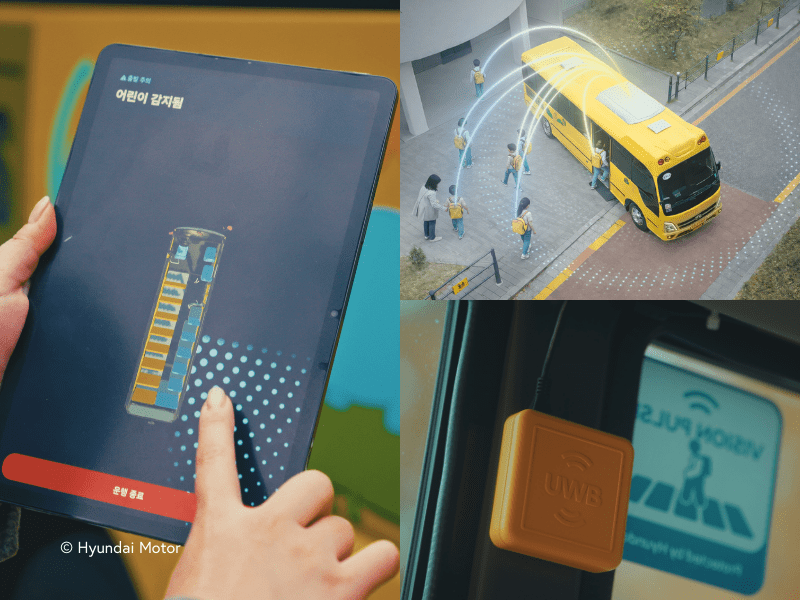
Hyundai and Kia outline UWB-based Vision Pulse driver safety system
Hyundai Motor Company and Kia have detailed a driver safety technology concept called Vision Pulse, which uses ultra-wideband (UWB) signals to detect obstacles beyond direct line of sight. The system is intended to support collision avoidance in complex urban and industrial environments where cameras and conventional sensors can be limited.
For eeNews Europe readers working on automotive electronics, ADAS architectures, or vehicle connectivity, the announcement provides insight into how UWB could be positioned as a complementary sensing layer. It also illustrates how existing in-vehicle hardware might be repurposed to support additional safety functions without relying solely on LiDAR or radar.
Using UWB for obstacle detection
Vision Pulse relies on UWB modules installed in vehicles to exchange signals with nearby objects that also carry UWB-enabled devices, such as smartphones, wearables, or trackers. By measuring signal time-of-flight, the system calculates relative positions and can issue alerts when a collision risk is detected.
According to Hyundai and Kia, the approach can achieve position accuracy of up to 10 cm within a radius of 100 m, including in visually obstructed scenarios such as blind intersections or poor weather. The companies state that detection accuracy remains above 99 percent under nighttime or adverse conditions, with communication latencies in the 1–5 ms range.
The technology is designed to integrate through additional UWB modules, although vehicles already equipped with Hyundai and Kia’s Digital Key 2 infrastructure would not require extra hardware. By leveraging UWB, the companies aim to reduce dependence on higher-cost sensors while maintaining functional safety targets.
Algorithms and broader use cases
To improve real-world usability, Hyundai and Kia have developed predictive algorithms that track multiple fast-moving objects simultaneously. This capability is intended to address scenarios involving pedestrians, cyclists, and other vehicles moving unpredictably around the car.
Beyond passenger vehicles, the companies see potential applications in industrial mobility and emergency response. Examples include collision prevention in warehouse environments and locating individuals under debris during disaster recovery operations.
Pilot testing is already underway in industrial settings. Since 2025, trials have been conducted at Kia’s PBV Conversion Center in Hwaseong to reduce forklift-related accidents. Additional trials are planned with the Busan Port Authority to evaluate interactions between industrial vehicles and workers.
Hyundai and Kia emphasise that Vision Pulse remains a pre-development technology, and any application in series-production vehicles is still under evaluation.
 If you enjoyed this article, you will like the following ones: don't miss them by subscribing to :