Li-ion battery protection ICs target small form-factor wearables
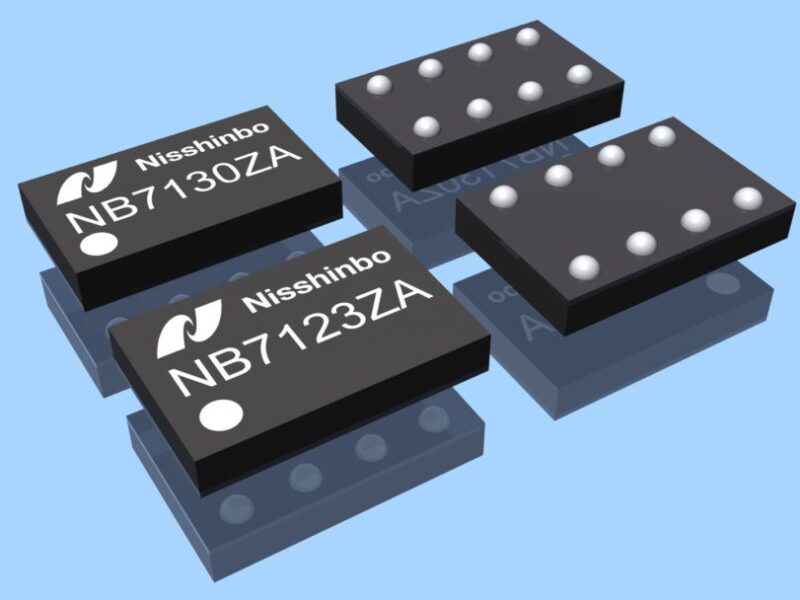
Nisshinbo Micro Devices has introduced two 1-cell Li-ion battery protection ICs, NB7123 and NB7130, designed for use in ultra-compact electronics such as wearables, hearing aids, smartphones, and handheld terminals. Both ICs integrate a range of precision safety features in WLCSP-8 packages optimized for space-constrained layouts.
For eeNews Europe readers designing battery-powered embedded systems, particularly in consumer or medical-grade applications, the level of configurability and accuracy in these devices may support safer, lower-heat, and longer-life battery operation in dense circuit footprints.
Safety and efficiency tailored for wearables
Both ICs support standard protections, including overcharge, over-discharge, overcurrent, and short circuit detection. However, the differentiator lies in the precision and configurability of these thresholds, which can be crucial when dealing with deeply embedded or body-worn devices where battery faults may pose a safety risk.
Key features include:
- High-accuracy detection: Overcharge and over-discharge thresholds are tightly defined (±6.5 mV and ±17 mV, respectively) to help prolong battery life by avoiding unnecessary cycling.
- Low sense voltage overcurrent protection: Enables the use of smaller sense resistors, reducing thermal dissipation under load.
- 0 V charging inhibition: Designed to prevent unsafe charging of deep-discharged cells, with programmable inhibition thresholds in 0.001 V steps.
- Thermal monitoring: A dedicated pin supports connection to an external sensor for monitoring cell temperature.
NB7123 supports high-side MOSFETs, simplifying layout by tying the control circuitry to battery ground. This also avoids signal level-shifting and can reduce board complexity in certain applications. A charge pump is integrated to drive the high-side gate without requiring external components. The NB7130 offers an alternative architecture with low-side MOSFET control, slightly lower quiescent current, and the same core protections.
Configurable standby modes and low power operation
Both devices include a standby control input that allows the IC to enter a low-power state until charging resumes. In standby, current consumption drops below 0.04 μA, making them suited for applications requiring long shelf life or infrequent charging.
The NB7123 and NB7130 are available now in WLCSP-8-ZA2 and WLCSP-8-ZA1 packages, respectively. Designers can configure a wide range of parameters, including hysteresis type, 0 V charging permission, and protection reset behaviour. Detailed configuration tables and typical performance curves are available in the respective datasheets.
For more technical details and distribution information, visit: https://www.nisshinbo-microdevices.co.jp/en/
 If you enjoyed this article, you will like the following ones: don't miss them by subscribing to :