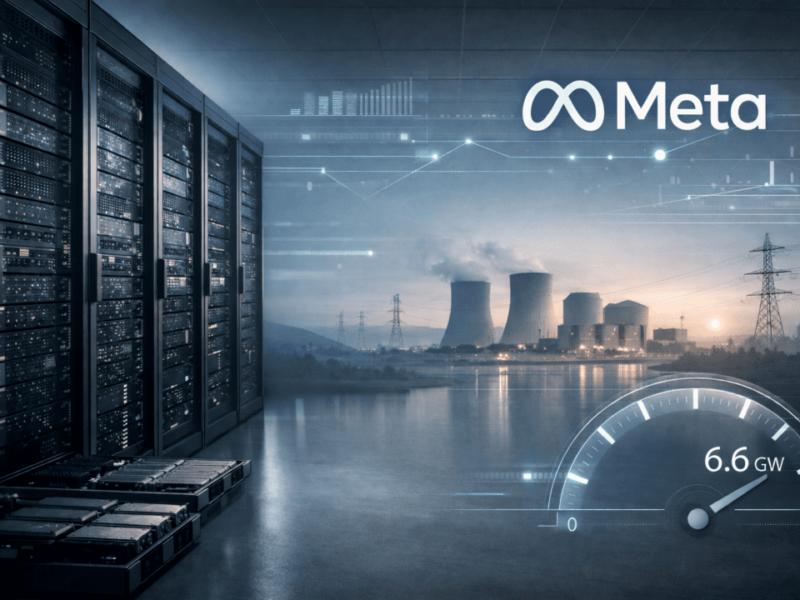
Meta nuclear power deals target 6.6GW for AI data centres
Meta says it has agreed a package of nuclear-energy supply and development deals intended to secure up to 6.6 GW of firm electricity for its AI data-centre build-out through 2035, with deliveries routed into the PJM grid region that serves large parts of the US Mid-Atlantic and Midwest. In the announcement, the company frames the move as an answer to power constraints facing hyperscale compute, while a separate report describes the scale as enough to supply millions of homes.
Rather than betting on a single project, the package mixes three levers: long-term offtake from existing reactors, funding for uprates to squeeze more capacity out of operating plants, and support for new-build “advanced” reactors that are still in the development-to-licensing pipeline. That blend matters because it spreads delivery risk: uprates and life-extension support can arrive earlier than greenfield builds, while new plants are the only way to add multi-gigawatt capacity at the pace AI operators are now modelling.
Meta nuclear power: existing plants, longer life and uprates
For the nearest-term capacity, Meta says it has agreements covering three operating nuclear sites: Perry and Davis-Besse in Ohio, plus Beaver Valley in Pennsylvania. The company says it will buy more than 2.1 GW from the two Ohio plants over 20 years, and it will financially support plant upgrades designed to raise output. Across the three sites, Meta says planned uprates total 433 MW, with that incremental capacity expected in the early 2030s.
In plain terms, this is a “keep the fleet running and make it slightly bigger” play. Uprates are unglamorous compared with shiny new reactors, but they are one of the few options that can add firm capacity without waiting for a brand-new site to clear permitting, financing, construction and commissioning. For data-centre operators, the attraction is that the grid gets more always-on generation sooner, which can reduce reliance on fossil-heavy marginal supply during peak demand periods.
Meta nuclear power: new-build bets for the 2030s
The second leg of the strategy is new capacity from advanced reactor programmes. Meta says it is backing development of two Natrium units with up to 690 MW of firm power, with delivery stated as early as 2032. It also says it has secured rights to power from up to six additional Natrium units totalling 2.1 GW, targeted for delivery by 2035. Meta describes the wider Natrium pipeline as eight potential units combining 2.8 GW of baseload generation and 1.2 GW of integrated energy storage.
Separately, Meta says a new nuclear campus planned for Pike County, Ohio, could deliver up to 1.2 GW of clean baseload power into PJM using multiple Aurora Powerhouse reactors, with the campus potentially coming online as early as 2030. Read together, these two tracks (Natrium plus the Ohio campus) are designed to create a second wave of firm supply that lines up with the steepest part of the AI compute ramp in the early-to-mid 2030s.
What this means for AI data centres and the PJM grid
Power procurement is becoming a first-order design constraint for AI infrastructure. Interconnection queues are long, transmission upgrades are slow, and even when there is land and money, the bottleneck can be firm generation that can run 24/7. Nuclear is one of the few low-carbon options that naturally fits that “always-on” requirement, which helps explain why multiple hyperscalers are now treating generation deals as part of their platform roadmap rather than a sustainability add-on. We looked at that broader shift in AI power curve prompts hyperscalers to go nuclear.
There’s also a messaging battle here. Meta explicitly argues that it will pay the full costs of the energy used by its data centres and that adding capacity supports reliability and price stability. Critics, meanwhile, tend to focus on whether these projects materially add new generation fast enough to keep up with load growth, and whether the benefits flow broadly to the grid or primarily to the largest new customers. The tension is likely to play out in how contracts are structured, how upgrades are approved, and how transmission is expanded to move power to the places where new compute campuses are landing.
Timelines and risks to watch
The promised schedule is ambitious. Uprates and life-extension support may be the “safer” part, but they still depend on outage windows, regulatory approvals and supply-chain execution. The new-build portion carries bigger uncertainties: first-of-a-kind deployments often slip, and financing terms can change sharply as projects move from announcement to steel-in-the-ground.
Still, the direction is clear: AI’s power appetite is forcing the industry to think in gigawatts and decades. Meta’s 6.6 GW headline number is less about a single plant and more about building a portfolio of firm power options that can scale with AI demand without betting everything on one technology, one site or one schedule.
 If you enjoyed this article, you will like the following ones: don't miss them by subscribing to :