Microchip expands 10BASE-T1S portfolio to accelerate zonal architecture adoption
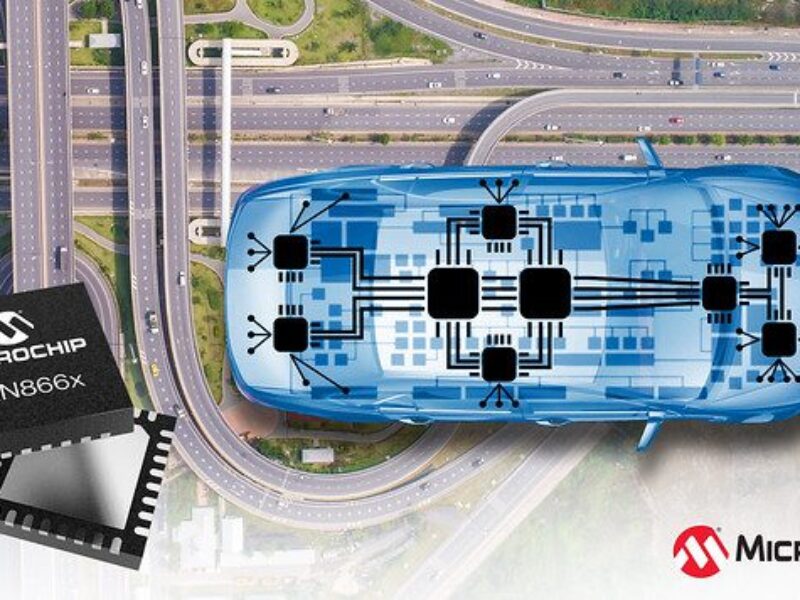
Microchip Technology has introduced the LAN866x family of 10BASE-T1S endpoint devices with Remote Control Protocol (RCP), aiming to simplify the shift toward zonal architectures and Software-Defined Vehicles (SDVs) in next-generation automotive designs. As automakers grapple with the growing number of sensors, actuators, and control modules in today’s vehicles, the ability to streamline connectivity across the entire network has become increasingly critical.
For eeNews Europe readers, this development is particularly relevant as it highlights how Single Pair Ethernet (SPE) continues to mature into a foundational technology for automotive, industrial, and building automation applications. These are all areas where design efficiency and network scalability directly impact competitiveness.
Software-free endpoints target zonal architecture complexity
Microchip notes that traditional automotive network nodes typically require microcontrollers and node-specific software — adding cost, increasing development time, and complicating system integration. Microchip’s new LAN866x endpoints take a different approach by eliminating the need for local software altogether. Serving as hardware-based bridges, the devices translate Ethernet packets directly into local digital interfaces. With RCP support, the endpoints allow centralized control of each node for device management and data streaming, reducing both silicon footprint and engineering overhead.
The LAN866x family leverages a 10BASE-T1S multidrop topology, enabling multiple nodes on a single twisted-pair line. This supports the industry’s desire for a unified, all-Ethernet architecture that lowers cabling requirements and system costs while simplifying integration across vehicle domains.
Automotive use cases
Microchip positions the LAN866x endpoints as ideal for automotive subsystems that require distributed control, including interior and exterior lighting, audio, and various sensor- and actuator-driven features. In such applications, the endpoints directly bridge Ethernet data to local LED drivers, microphone and speaker interfaces, or other control components, helping OEMs deploy smarter and more centralized zonal strategies.
SPE portfolio continues to expand
The introduction of the LAN866x family builds on Microchip’s broader Single Pair Ethernet ecosystem, which spans transceivers, bridges, switches, and development hardware. The company supports 10BASE-T1S, 100BASE-T1, 1000BASE-T1, and higher-speed variants, offering scalable solutions for automotive and industrial innovators working to unify network topologies and reduce wiring complexity.
As Ethernet gains traction across vehicle domains — and as SDVs demand more centralized, software-defined control — Microchip’s SPE roadmap positions the company to play an increasingly prominent role in next-generation automotive network design.
 If you enjoyed this article, you will like the following ones: don't miss them by subscribing to :