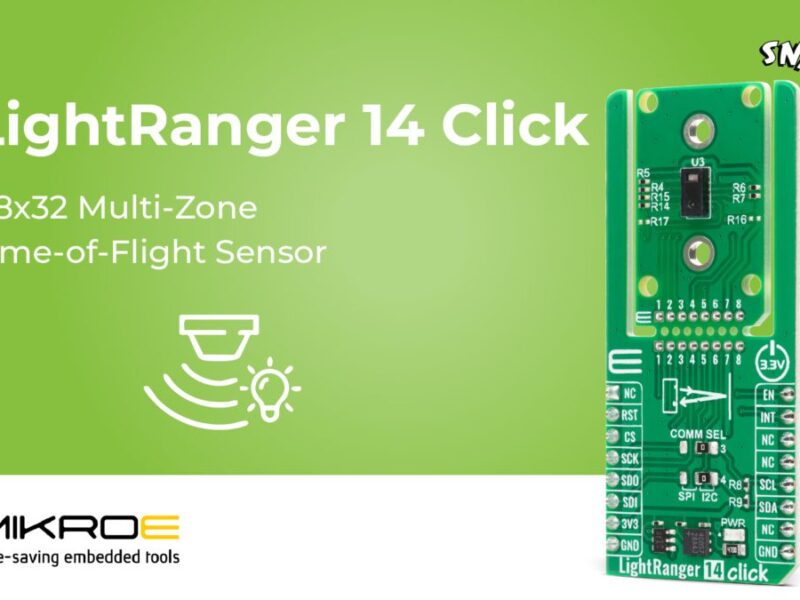
MIKROE’s LightRanger 14 Click brings dToF-based 3D sensing to rapid prototyping
MIKROE has expanded its optical sensor portfolio with the LightRanger 14 Click, a compact add-on board designed to deliver high-precision distance and depth measurement using direct time-of-flight (dToF) technology. The new Click board targets applications ranging from people counting and to robotics and autofocus systems.
For eeNews Europe readers, the announcement is relevant as it highlights how advanced 3D sensing technologies are becoming more accessible at the prototyping stage. By packaging a multi-zone dToF sensor into a standardized Click board format, MIKROE aims to shorten evaluation cycles and accelerate the development of spatially aware embedded systems.
Multi-zone dToF Sensing in a Compact Module
LightRanger 14 Click is based on the TMF8829 from ams OSRAM, a high-performance multi-zone dToF sensor integrating SPAD detection, time-to-digital conversion and histogram processing. The device supports configurable depth map resolutions of 8×8, 16×16, 32×32 and 48×32 zones, enabling flexible trade-offs between spatial resolution and processing load.
The sensor covers detection ranges from 10 mm to 11,000 mm, with a fine resolution of 0.25 mm and an 80° field of view. An integrated VCSEL combined with a multi-lens array (MLA) ensures uniform illumination and robust performance, even under challenging optical conditions. According to MIKROE, this makes the board suitable for demanding real-time ranging and depth-sensing applications.
“This new Click board is ideal for applications such as laser autofocus (LDAF), robotics, SLAM, gesture recognition, and people counting systems,” said Nebojsa Matic, CEO of MIKROE. “It is part of our 100-strong family of optical sensor Click boards and over 800 projects – with working code – featuring the LightRanger 14 Click can be found on MIKROE’s embedded projects platform EmbeddedWiki.”
mikroBUS Integration and Software Support
The LightRanger 14 Click offers both I²C (I3C-compatible) and SPI interfaces, along with dedicated pins for control and interrupt signalling. As a mikroBUS-enabled board, it can be used with any host system supporting the mikroBUS standard, which is widely adopted across microcontroller and processor evaluation platforms.
The board also includes ClickID functionality, allowing automatic identification by the host system and simplifying setup during evaluation and prototyping. Like other Click boards, it is supported by mikroSDK open-source libraries, giving developers access to ready-to-use drivers and examples that can be adapted for custom applications.
LightRanger 14 Click is a recent addition to MIKROE’s portfolio of more than 1,800 Click boards, covering sensors, connectivity, power management and interface functions. By combining standardized hardware, open software tools and a large ecosystem of example projects, MIKROE continues to position its Click platform as a fast path from proof-of-concept to functional prototype for embedded and edge AI systems requiring 3D perception.
 If you enjoyed this article, you will like the following ones: don't miss them by subscribing to :