Mobileye imaging radar in SAE Level 3 eyes-off driving win
Following an extensive years-long evaluation of the technology and competing systems, the Mobileye Imaging Radar will deliver SAE Level 3 automated driving in vehicles at highway speeds, commencing in 2028. Designed to provide safe and scalable autonomous driving systems, the 4D radar delivers exceptional detection of vehicles, people, and objects in conditions such as fog or rain, even at long distances.
In development since 2018, the 4D imaging radar was designed to provide sensor redundancy through superior perception in challenging lighting, environmental, and traffic scenarios, complementing camera-based perception at affordable costs.
“The selection of our imaging radar by this new customer validates the groundbreaking work we undertook to develop our imaging radar,” said Mobileye President and CEO Prof. Amnon Shashua. “After recognising how important this sensing modality would be to autonomous driving, we built what we believe is the industry’s standard for imaging radar that can deliver the safety and accuracy self-driving systems require.”
Current automotive radars provide estimates of distance from an object, their rough direction on a horizontal plane and relative velocity. Imaging radars add height as an additional dimension. Built on a groundbreaking architecture, the Mobileye Imaging Radar processes the entire signal digitally from end to end, employing a specially designed radar processor to deliver unprecedented levels of accuracy, detail, and reliability in environmental perception.
The imaging radar incorporates advanced RFIC technology to ensure exceptional flexibility in signal transmission and the capacity to receive and sample the entire radar signal across a broad bandwidth, all while maintaining low noise levels.
The RFICs are embedded in a unique architecture where the entire radar signal is sampled and digitally processed by a dedicated proprietary processor with a computing capability of 11 TOPS. This processor can handle more than 1,500 virtual channels at a high frame rate of 20 frames per second. The massive antenna array also delivers exceptional angular resolution of below 0.5 degrees, ultra-low side-lobe levels of -40 dBc, and a market-leading dynamic range of 100 dB, compared to 60 dB in other automotive radars.
The Mobileye Imaging Radar detects small, distant objects, even in complex scenarios with large nearby vehicles, such as trucks or buses. It also provides precise detection of small hazards, like a tyre near a guardrail at a great distance, which is critical for safe autonomous highway driving at speeds above 75 mph or 130 kph. The radar detects road users, including pedestrians, motorcycles, and cyclists, at a distance of up to 315 meters and identifies potential hazards up to 230 meters away. Crucially, where traditional radar systems often fail, such as in tunnels, construction zones, and other complex, cluttered environments, Mobileye Imaging Radar excels.
The forward-facing BSR version of the radar uses its full sensing capabilities, while a smaller BSRC version for corner-mounted use has more than 300 channels.
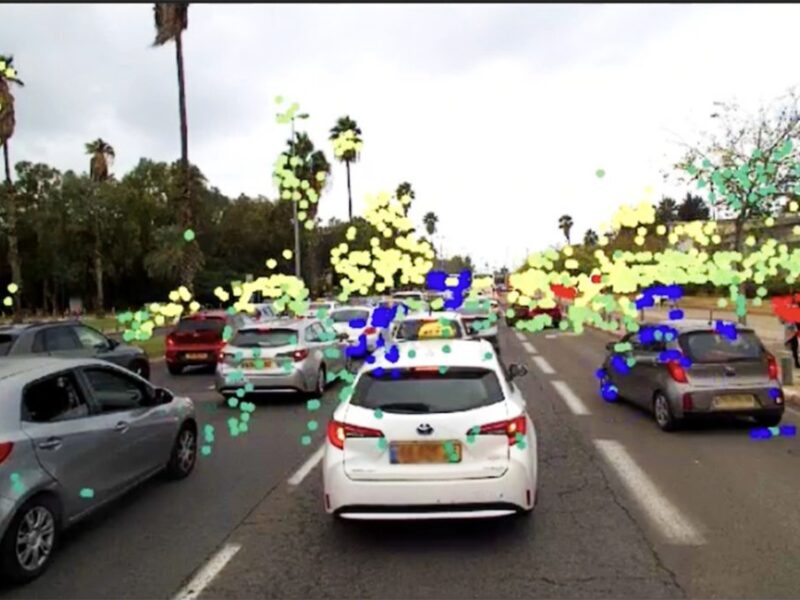
Image: Colored dots simulate the dense data generated by Mobileye Imaging Radar™, offering higher precision than previous systems. Courtesy of Mobileye.
 If you enjoyed this article, you will like the following ones: don't miss them by subscribing to :