Next-gen facial recognition senses live skin
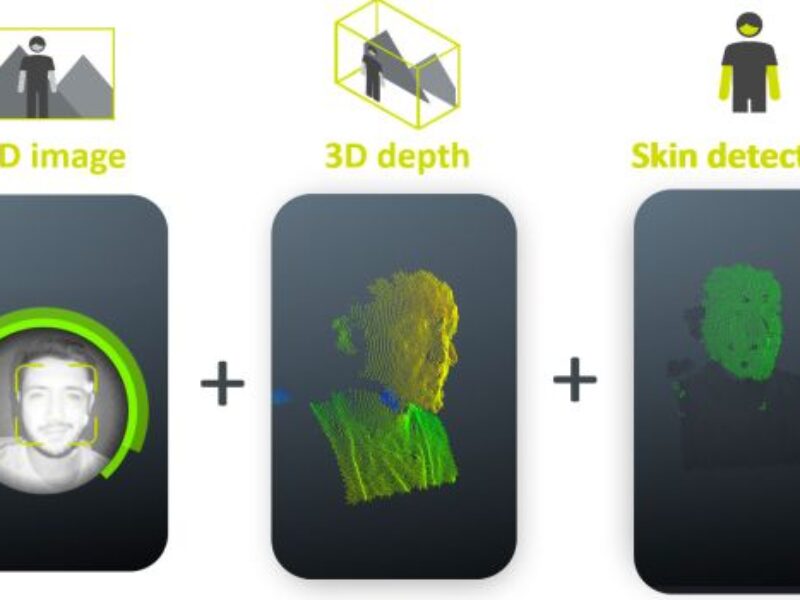
Through the collaboration, OEM customers will now be able to use trinamiX’ proprietary “Beam Profile Analysis” technology, which extracts three data streams – a 2D infrared (IR) image, a 3D depth map, and material classification – from a single camera system. This new approach to security, says the company, makes it possible to combine standard facial recognition algorithms from any third party with the unique ability to sense “live skin” – eliminating the ability to fool the phone into unlocking via a mask, a high-resolution print, or even a 3D rendering of the rightful owner’s facial features.
The material classification ability – which classifies and identifies materials based on their physical properties – is accomplished through the company’s proprietary algorithms that run on the Qualcomm Hexagon Processor on Qualcomm Snapdragon mobile platforms.
“trinamiX has distinguished itself by providing the world’s most innovative 3D imaging solution using our Beam Profile Analysis technology,” says Dr. Ingmar Bruder, Managing Director and founder of trinamiX, “and we are thrilled to be working with Qualcomm Technologies, the world’s leading wireless technology innovator. Using our patented 3D imaging technology, the solution will enable mobile devices powered by the Hexagon Processor inside Snapdragon mobile platforms to achieve a previously unattainable goal – the ability to sense live skin as part of a secure facial recognition.”
The company’s beam profile analysis technology uses sensors in a “low complexity” system setup consisting of an IR imaging camera and a light projector. It works by measuring an object by illuminating it with a light source emitting a regular dot pattern. The reflection of each light spot is captured by a sensor (e.g., a CMOS camera) and its beam profile is then analyzed, from which the distance and information about the material of the measured object is extracted.
The technology, says the company, enables an industry-leading, secure, and robust facial recognition solution for devices ranging from smartphones to laptops and up to securing access control systems.
Related articles:
3D sensing platform targets access control, smart video security
Light sensors to boom due to ‘iPhone effect’
3D sensing on verge of mass adoption
AR smart glasses to merge with AI, computer vision to ID images
Simple ‘smart’ glass recognizes images
 If you enjoyed this article, you will like the following ones: don't miss them by subscribing to :