NVIDIA teams with industrial software giants to advance AI engineering
NVIDIA is teaming up with leading industrial software providers to bring AI-driven automation into design, engineering and manufacturing workflows, marking a significant shift toward what it calls the next industrial revolution. The initiative, unveiled at GTC, spans the semiconductor, automotive, aerospace and energy sectors.
For eeNews Europe readers, the announcement highlights how GPU acceleration and AI agents are reshaping engineering workflows, cutting simulation times and accelerating time to market across multiple industries.
AI agents reshape engineering workflows
At the core of the announcement is the rise of “agentic AI” — autonomous software agents capable of orchestrating complex engineering tasks. Companies including Cadence, Dassault Systèmes, Siemens and Synopsys are integrating NVIDIA’s CUDA-X libraries, Omniverse platform and AI models into their tools to automate chip design, verification and system-level workflows.
These AI agents can handle tasks such as design coding, debugging and workflow orchestration, reducing manual effort and enabling engineers to focus on higher-level innovation.
“The dawn of a new industrial revolution has arrived, where physical AI and autonomous AI agents are fundamentally reinventing how the world designs, engineers and manufactures,” said Jensen Huang, founder and CEO of NVIDIA. “Uniting our global ecosystem of software giants, cloud providers and OEMs, NVIDIA is delivering a full-stack accelerated computing platform that empowers every industry to turn this vision into reality at a scale and speed never before possible.”
The solutions are deployed across major cloud providers including AWS, Google Cloud, Microsoft Azure and Oracle Cloud, as well as on-premises systems from Dell, HPE and Supermicro, enabling scalable and hybrid deployments.
Faster simulations transform automotive and aerospace
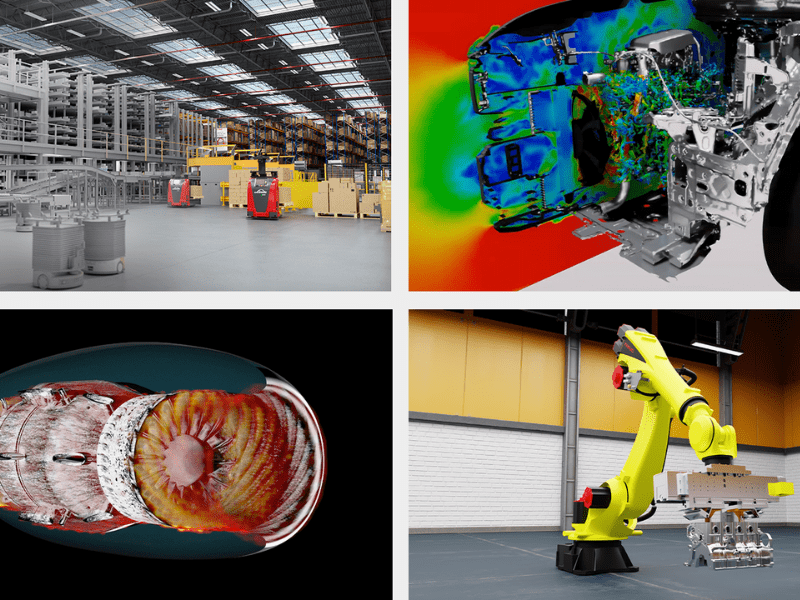
A key impact area is simulation. GPU-accelerated tools are replacing traditional CPU-based workflows that often take weeks, enabling engineers to run high-fidelity simulations in hours or even minutes.
In automotive design, Honda is using GPU-accelerated computational fluid dynamics (CFD) tools to achieve up to 34x faster aerodynamic simulations, significantly shortening development cycles. Meanwhile, Jaguar Land Rover and Mercedes-Benz are leveraging NVIDIA-powered Siemens software to refine vehicle aerodynamics using cloud-based infrastructure.
In aerospace, companies are using NVIDIA-accelerated solvers to run complex simulations such as aircraft takeoff scenarios at unprecedented scale. For example, hybrid electric aircraft developer Ascendance can now complete full aerodynamic simulation campaigns within a single day.
Semiconductor and energy sectors accelerate adoption
The semiconductor industry is also embracing GPU acceleration as chip complexity grows beyond Moore’s law. Companies such as Samsung, SK hynix, MediaTek and TSMC are deploying NVIDIA-powered tools for lithography, verification and circuit simulation, achieving multi-fold speedups compared to CPU-only systems.
Similarly, energy companies are using GPU-accelerated simulations to design more efficient gas turbines and combustion systems. This enables faster iteration and supports the transition to cleaner energy solutions.
Digital twins drive smarter manufacturing
Beyond design, NVIDIA and its partners are advancing industrial digital twins — virtual replicas of factories, warehouses and production lines. Using Omniverse, companies like HD Hyundai, PepsiCo and KION are building large-scale simulation environments to optimize operations in real time.
These digital twins allow engineers to test scenarios virtually before deploying them in the physical world, improving efficiency and reducing costs. In logistics, for instance, KION is developing autonomous warehouse systems by training AI-powered forklifts within simulated environments.
Overall, NVIDIA’s ecosystem push signals a broader shift toward AI-native engineering, where simulation, automation and real-time data converge to redefine industrial innovation.
 If you enjoyed this article, you will like the following ones: don't miss them by subscribing to :