PCIe digitizer upgrade for streaming data
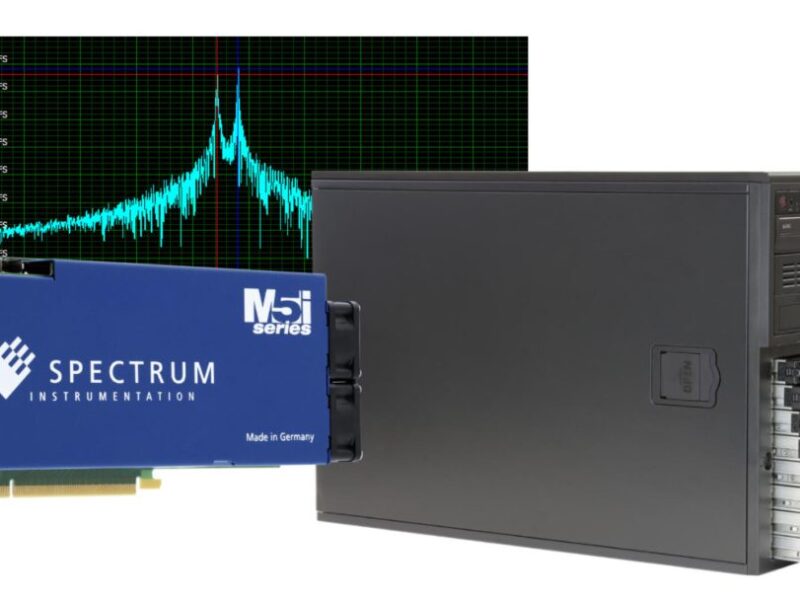
Spectrum Instrumentation in Germany has added a streaming mode and 8bit capture to its flagship digitizer cards to capture up to 6 hours of high speed data
The streaming mode allows the PCIe digitizer cards to continuously acquire, stream and analyse data at a maximum sampling rate of 10 GS/s. The new capability enables the digitizers to be used with COTS (Commercial Off-The-Shelf) PC technology, such as GPUs for endless signal processing, and SSD arrays to create streaming systems that can record for hours on end.
The M5i.33xx digitizer family consists of seven different models, offering sampling speeds from 3.2 to 10 GS/s, 12-bit vertical resolution and bandwidths from 1 to 4.7 GHz. The different product variants all feature a 16-lane PCIe 3.0 bus, that is capable of transferring data at rates up to 12.8 GB/s. This allows data, acquired on one channel at a sampling rate of 6.4 GS/s, or two channels at 3.2 GS/s, to be streamed directly to the PC environment without any loss of information.
If faster sampling rates are needed, a special 8-bit transfer mode has been added that supports the streaming of data acquired at rates up to 10 GS/s on one channel, or 5 GS/s on two.
For situations that involve streaming and intensive signal processing, the M5i.33xx series digitizers use SCAPP (Spectrum CUDA Access for Parallel Processing). The SCAPP software package transfers the acquired data, using an RDMA process, directly from the digitizers to off-the-shelf GPUs based on Nvidia’s CUDA Standard.
SCAPP includes a set of routines for interaction between the digitizer and GPU cards, as well as a set of CUDA parallel processing examples. These examples provide easy building blocks for powerful processing functions like Digital Down Conversion (DDC), filtering, signal averaging, data de-multiplexing, data conversion or Fast Fourier Transforms (FFTs). All the SCAPP software is based on C/C++ and Python.
In applications that require continuous spectral analysis, time domain data can be collected at 10 GS/s and streamed directly to a GPU for non-stop conversion to the frequency domain. Using a system that includes an M5i.33xx series digitizer (switched to the new 8-bit-mode), SCAPP and a moderately priced GPU, a conversion process that involves multiplexing, windowing, FFT and averaging with an FFT block size of 1M – could run endlessly says the company.
At the 10 GS/s sampling rate, such an FFT will cover a frequency range from DC to 5 GHz and deliver a frequency resolution of 10 kHz. Larger FFT block sizes can also be used to produce even better resolutions.
The company also offers streaming and data storage systems based on a Supermicro server, with an AMD EPYC processor, and RAID storage using U.2 SSDs. With up to 240 TB of storage, these COTS systems can record over six hours of data at the maximum 10 GS/s sampling rate. The acquired data is completely seamless, with no gaps or missing information. Once stored, it can be inspected, partitioned, and processed. The systems provide a unique data logging capability at unprecedented speeds and over ultrawide frequency ranges.
“We’re always looking for ways to provide cost-effective solutions to challenging signal acquisition and analysis applications. By allowing our digitizers to interface directly with standard PC components, like GPUs and RAID based SSD storage systems, our customers can benefit directly from the latest developments in the PC world,” said Oliver Rovini, CTO at Spectrum.
“GPUs offer a great solution for processing intensive situations, like those often found in imaging, communications, astronomy, spectroscopy and aerospace applications while storage systems provide a unique tool for anyone needing to monitor signals over extended time periods, such as for those users involved in quality control, mapping or surveillance.”
The digitizers can be programmed with a variety of popular languages including C, C++, C#, Delphi, VB.NET, J#, Python, Julia, Java, LabVIEW, and MATLAB. An SDK is provided that contains an assortment of programming examples and the necessary driver libraries for running with either Windows or LINUX operating systems. For situations that require a turnkey solution, the company also has its own measurement software, SBench 6 Professional, which provides full card control, along with display, analysis, storage, and documentation capabilities. SBench 6 is designed to handle large data files and has a number of processing tools, including a plug-in interface that allows the use of custom calculation functions, as well as variety of import and export filters.
The M5i.33xx series digitizers and streaming systems are available now. The new 8-bit transfer mode is part of every M5i digitizer card.
spectrum-instrumentation.com/products/families/33xx_m5i_pcie.php
 If you enjoyed this article, you will like the following ones: don't miss them by subscribing to :