
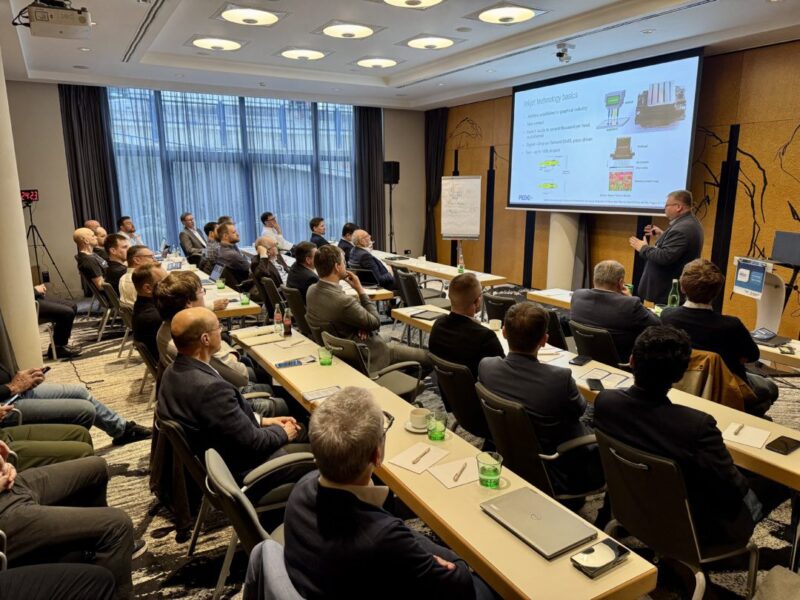
PEDC conference strengthens Europe’s electronics design ecosystem
The second Pan-European Electronics Design Conference (PEDC) in Prague has reinforced its role as a growing focal point for collaboration across Europe’s electronics design community. Organised jointly by the German Electronics Design and Manufacturing Association (FED) and the Global Electronics Association, the event brought together participants from 19 countries across three continents.
For eeNews Europe readers involved in electronics development, manufacturing and supply-chain strategy, the conference highlights how European industry stakeholders are aligning around AI-driven design, sustainability challenges and next-generation connectivity standards. It also reflects increasing efforts to build a more resilient regional electronics ecosystem.
Aligning European design strategy
In opening remarks, organisers stressed the importance of strengthening cooperation across Europe’s fragmented electronics landscape. The conference is intended to support cross-border knowledge transfer while addressing structural challenges facing the industry, including AI adoption and supply-chain resilience.
Dieter Mueller, Chairman of the FED, underlined the strategic urgency of collaboration. “This year’s PEDC in Prague has clarified the urgency of harmonizing design processes at a European level. It is no longer just about exchanging best practices, but about actively shaping a resilient ecosystem that meets the demands of AI integration and technological sustainability.”
Matt Kelly, CTO of the Global Electronics Association, also emphasised Europe’s role as a technology hub and the need for stronger industry coordination across design and manufacturing domains.
AI, power electronics and connectivity trends
The two-day programme featured keynote presentations, 36 technical sessions and panel discussions focused on major industry transitions. Topics ranged from AI-assisted hardware development to sustainable infrastructure and industrial communication technologies.
Tomide Adesanmi of Circuit Mind examined the practical opportunities and limitations of AI-based automation in electronics design workflows. Meanwhile, Alexander Gerfer of Wuerth Elektronik eiSos addressed the growing energy demands of AI systems and the role of advanced power electronics in enabling sustainable deployment.
Connectivity was another central theme. Simon Seereiner of Weidmueller and Thomas Keller of Rosenberger presented Single Pair Ethernet (SPE) as an emerging communication standard capable of supporting seamless connectivity from sensors to cloud platforms in industrial and automation environments.
Panel discussions expanded on these themes, exploring how AI-enabled design tools, sustainable engineering practices and supply-chain resilience can be balanced without slowing development cycles.
Networking and industry engagement
The Prague event also saw growth in its exhibition component, with 18 companies presenting electronics design tools, services and technologies. The exhibition area served as a networking hub where engineers, suppliers and decision-makers exchanged practical insights and discussed implementation challenges.
Organisers reported strong feedback from participants, highlighting the event’s international reach and technical focus.
“The positive feedback and the high level of internationality, with guests from 19 countries, show us that the PEDC has filled a gap in the European conference landscape,” concluded Christoph Bornhorn, Executive Director of the FED.
With its second edition completed, the PEDC is positioning itself as a recurring platform for aligning Europe’s electronics design community around emerging technologies, collaborative development models and long-term industrial resilience.
 If you enjoyed this article, you will like the following ones: don't miss them by subscribing to :