Perovskite tandem solar cell with 30.9% efficiency
 Cette publication existe aussi en Français
Researchers at EPFL in Switzerland have demonstrated a tandem silicon perovskite photovoltaic cell design combining additive and substrate engineering that yields consistently high power conversion efficiencies.
Perovskite silicon (Si) tandem solar cells are the most prominent contenders to succeed single-junction Si cells that dominate the market today. EPFL has already shown a tandem cell with a record efficiency of 31.25%.
However, to justify the added cost of inserting a perovskite cell on top of Si, these devices should first exhibit sufficiently high power conversion efficiencies (PCEs).
Machine learning accelerates discovery of solar-cell perovskites
The researchers at EPFL boosted the efficiency of tandem devices with a perovskite material spin coated onto front-side flat silicon wafers.
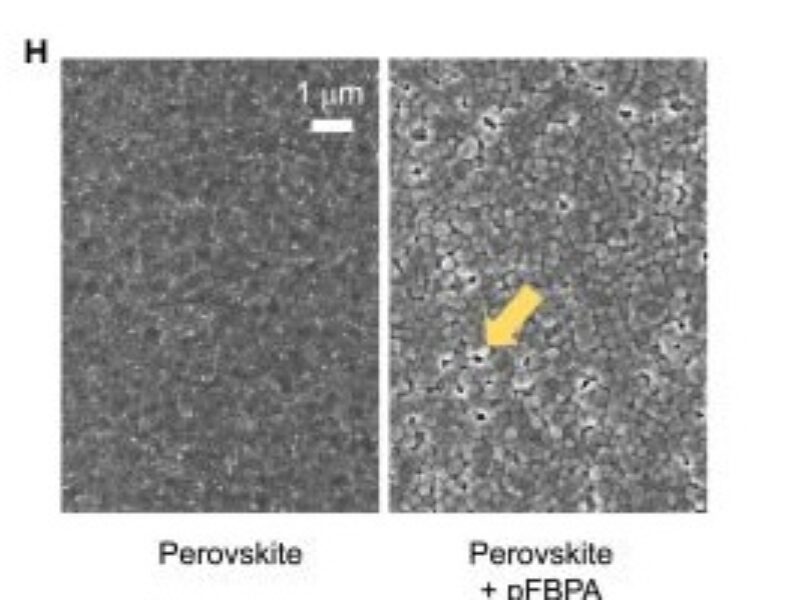
The researchers used 2,3,4,5,6-pentafluorobenzylphosphonic acid (pFBPA) in the precursor ink to suppress recombination near the perovskite/C60 interface. This boosts the open-circuit voltage (Voc) and fill factor (FF) of the devices without the need for an additional passivating layer, reducing the complexity of the manufacturing process.
The second development, enhancing the fill factor, comes from using sparsely coated SiO2 nanoparticles (NPs) as an interlayer between the perovskite and the hole transport layer (HTL). This suppresses the number of pinholes and shunts introduced by pFBPA.
Integrating these developments in an optically and electrically optimized tandem device showed reproducible PCEs of 30 ± 1%, and a certified maximum of 30.9% are achieved.
 If you enjoyed this article, you will like the following ones: don't miss them by subscribing to :