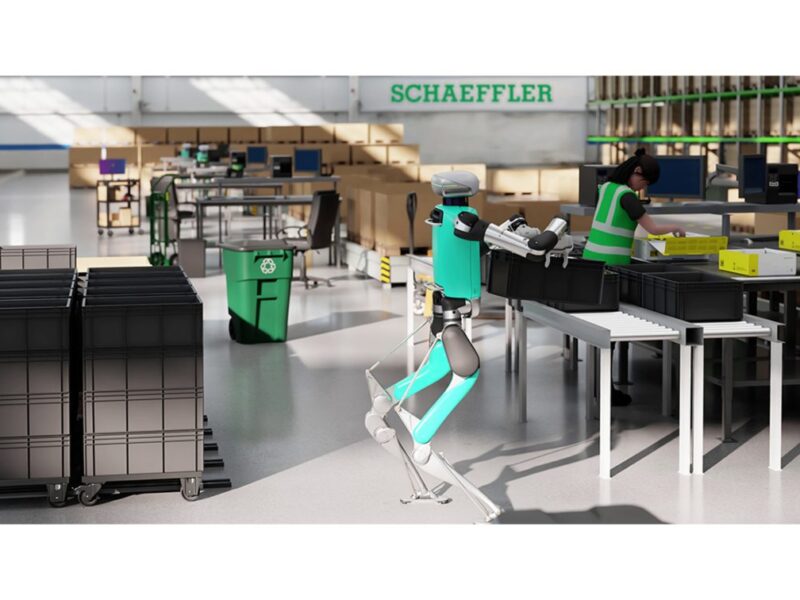
Proof of concept reveals a path to industrial humanoid robots
At Hannover Messe 2025, Accenture and Schaeffler AG showcased a three-level proof of concept (PoC) for optimising various work scenarios, ranging from human-centric approaches to human collaboration with robots and full automation, utilising the latest simulation, AI, and data technologies from NVIDIA and Microsoft.
These scenarios include industrial automation systems, autonomous mobile robots (AMRs), the mobile manipulator cobot EMMA from Schaeffler, and general-purpose humanoid robots like Digit from Agility Robotics and Phoenix from San ctuary AI. Accenture made a strategic investment in Sanctuary AI in March 2024.
According to a recent Accenture research report, half of industrial company factory managers (49%) expect AMRs to be a key element of future factories, and 43% believe humanoid robots will become a standard component of assembly processes.
“As a leading motion technology company, Schaeffler leverages disruptive innovations such as physical AI, digital twins, and humanoid robots to enhance operational excellence across our global manufacturing network,” said Andreas Schick, Chief Operating Officer at Schaeffler AG. “In collaboration with strong partners like Accenture, we constantly explore how disruptive technologies from NVIDIA and Microsoft can increase our flexibility and efficiency. This is how we want to jointly shape the production of the future.”
“Physical AI is reinventing industrial automation as it offers efficient ways to train and control entire fleets of AMRs, mobile adaptive manipulators and general-purpose humanoid robots,” said Patrick Vollmer, Global Industry Group Lead, Industrials, Accenture. “Our collaboration with Schaeffler, Microsoft and NVIDIA shows how clients and strategic partners can co-innovate on turning emerging technologies into solutions to help manufacturers tackle flexibility, productivity and workforce challenges.”
The proof of concept that demonstrates the benefits of AI-powered simulations possible in Schaeffler’s factories and distribution centres consists of three layers:
Planning the ideal facility
Accenture’s ability to create digital twins of factories and warehouses on the NVIDIA Omniverse development platform enables Schaeffler to simulate and determine the optimal layout for facilities in advance, thereby reducing commissioning times. This encompasses virtually positioning production lines and kitting stations for efficient material flow and seamless collaboration between humans and robots.
Virtual commissioning can also assist Schaeffler in determining the appropriate level of automation for each facility. The PoC encompasses scenarios featuring various physical AI types: primarily manual labour, AMRs aiding in transport tasks, and adaptive manipulators like EMMA and general-purpose humanoid robots in highly automated environments.
Physical AI and general-purpose humanoid robots
Accenture and Schaeffler are beginning to adopt Mega, an NVIDIA Omniverse Blueprint, to test robot fleets, including general-purpose humanoid robots, in industrial digital twins of factories and warehouses.
The PoC showcases Agility Robotics’ Digit executing material handling tasks, including tote handling and transporting items to kitting and commissioning areas. It also illustrates how Sanctuary AI’s multi-dexterous humanoid robot, Phoenix, acquires real-world skills in Omniverse by observing simulations. One example involves compiling spare part kits for individual orders in one of Schaeffler’s spare part centres. This imitation learning technique is enhanced by vision AI applications like NVIDIA Metropolis, which captures the movements of human workers and humanoid robots in the real world, translating them back into simulations within Omniverse.
“Tomorrow’s factories require complex collaboration between humans, industrial automation systems and multi-robot fleets,” said Mike Geyer, head of digital twins at NVIDIA. “By using Mega and NVIDIA Omniverse to simulate and test various types of robots at scale in industrial digital twins, Accenture and Schaeffler are reinventing their industrial operations with physical AI.
Optimising live robotics operations
Accenture and Avanade are collaborating with Schaeffler to utilise simulated data from Omniverse to optimise the physical performance of robots in the warehouse and on the shop floor — for instance, to prevent congestion. Avanade is a joint venture between Accenture and Microsoft. Data from various simulated scenarios is fed into Microsoft Fabric, a unified, AI-powered data platform. Site managers and workers responsible for operations can then compare key performance indicators, such as availability, utilisation, and overall equipment effectiveness for these scenarios. This allows them to identify potential issues in time to take action.
Accenture and Avanade developed a solution for Schaeffler’s production site in Schweinfurt, Germany, utilising MS Fabric alongside a generative AI-powered factory operations agent. This tool helps staff gain production insights and resolve issues more quickly by allowing them to ask questions in natural language. Looking ahead, virtual factories can be onboarded, allowing engineers and planners to interact intuitively with simulation data of robots and production systems, for instance, by accessing dashboards and altering simulation parameters through voice commands.
www.accenture.com
www.schaeffler.com/en
 If you enjoyed this article, you will like the following ones: don't miss them by subscribing to :