Raspberry Pi celebrates 10 years
Raspberry Pi is ten years old today. The first commercial orders were taken on February 29th 2012, although they only shipped eight months later, the first of over 45m boards.
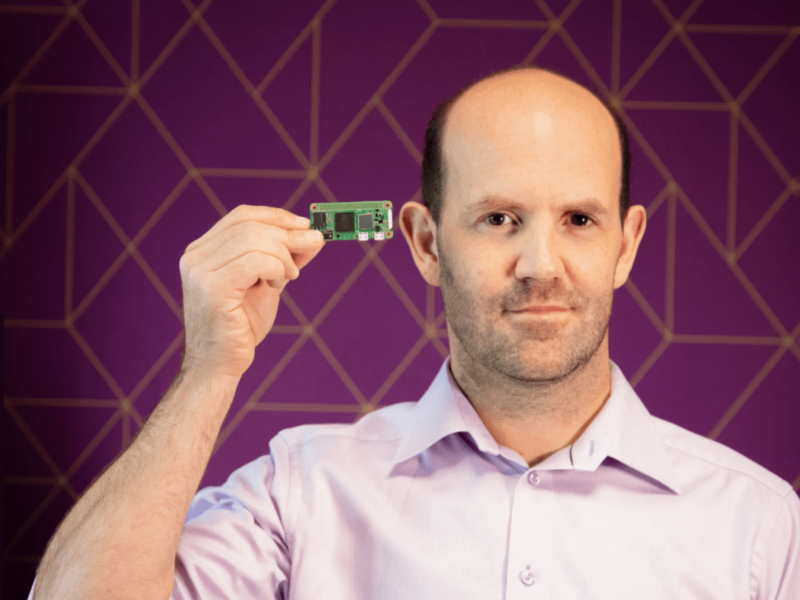
“Almost exactly ten years ago today, thousands of you set your alarms, and woke on leap-day morning to discover that we’d started selling Raspberry Pi computers,” said Eben Upton, CEO of Raspberry Pi (above). “By the time our all-volunteer team gathered in the pub that evening for celebratory drinks, our licensees Farnell and RS Components had taken over 100,000 orders, despite struggling to keep their websites online under the load and we had briefly out-trended Lady Gaga so Raspberry Pi was on the road to becoming a little larger than we’d planned.”
- Raspberry Pi apologises for first ever price increase and allocation
- Raspberry Pi shortage driven by demand
- Raspberry Pi raises $45m for expansion
The volunteers in Cambridge founded the Raspberry Pi Foundation in 2008, aiming to reverse the decline in applications to study Computer Science at Cambridge by providing young people with a fun, robust, low-cost computer with which they could learn to program. A demonstration of a prototype board in May 2011 boosted the interest in the project
“After some early road bumps, first production units arrived in the UK at the end of March, and volumes continued to ramp through the spring. By the end of October, we’d shipped our launch-day orders; taken Raspberry Pi to Maker Faires in the Bay Area and New York; demoed a working prototype of the first Camera Board; started building Raspberry Pi at the Sony UK Technology Centre in South Wales; doubled the shipping memory capacity of Model B to 512MB; and produced first samples of the cut-down $25 Model A,” he said. “In the end, we sold a million units in our first twelve months.”
“In the ten years since, we’ve built a company, a charitable foundation, and a movement that has begun to change the world,” he said. “We’ve launched five more generations of the core Raspberry Pi platform, starting with Model 1B+ in 2014, and culminating with Model 4B in 2019. We’ve built Compute Modules and all-in-one PCs, and produced cameras, displays, cases, cables, and a whole planet of HATs (add on modules).”
Raspberry Pi has expanded to ship its own silicon microcontroller in volume, and seen its ‘all in one’ Linux PC in a keyboard emulated in a recent patent from Apple.
“To date, we’ve sold over 45 million Raspberry Pi computers,” said Upton. “Our profits have helped to fund the work of the Raspberry Pi Foundation, which has grown over the last ten years to become one of the most important global players in STEM education.”
“The Foundation creates curricula and teacher training programmes that are helping to improve the quality of computing education in tens of thousands of schools; millions of young people are learning how to program through their free online resources, networks of Code Clubs and CoderDojos, and partnerships with youth and community organisations; and their world-class research is helping to advance our understanding of what works, and what doesn’t, in the field,” he said.
“It’s been a wild ride. So, here’s to ten years of Raspberry Pi, and here’s to what we’ll all do, together, in the next ten,” he said.
Related articles
- First Raspberry Pi recycling scheme from Sony, Okdo
- Raspberry Pi goes 64-bit
- Raspberry Pi controller available as silicon
- First industrial programmable I/O module with Raspberry Pi
Other articles
- ALD centre of excellence to drive leading edge process technology
- Large woven display for the smart home and IoT
- First quantum network for blockchain
- Behind the new PICMG box PC standard
- Sequans, MicroEJ port edge container to cellular IoT chip
 If you enjoyed this article, you will like the following ones: don't miss them by subscribing to :