R&D consortium to reduce carbon footprint of fab gases
Intel has announced plans to further reduce its direct and indirect greenhouse gas emissions to achieve net-zero greenhouse gas emissions in its global operations by 2040.
This is behind other semiconductor vendors such as STMicroelectronics and Infineon, but does include a key commitment for a global R&D consortium to develop chemicals for chip making with less environmental impact.
Related articles
- Pressure builds to cut greenhouse gas emissions across the chip supply chain
- Chip makers withdraw from Russia over Ukraine war
- Boom for 200mm fab capacity
- Dell’s Luna project aims to reduce e-waste
The announcements re-hash a number of existing projects such as Dell’s Project Luna to reduce e-waste and adding solar cells to car ports. The commitment to using totally renewable energy by 2030 is well behind other large users of energy such as data centre operators that have already committed to using 100% renewable energy.
“Intel is in a unique position to make a difference not only in our own operations, but in a way that makes it easier for customers, partners and our whole value chain to take meaningful action too,” said Pat Gelsinger, Intel chief executive officer.
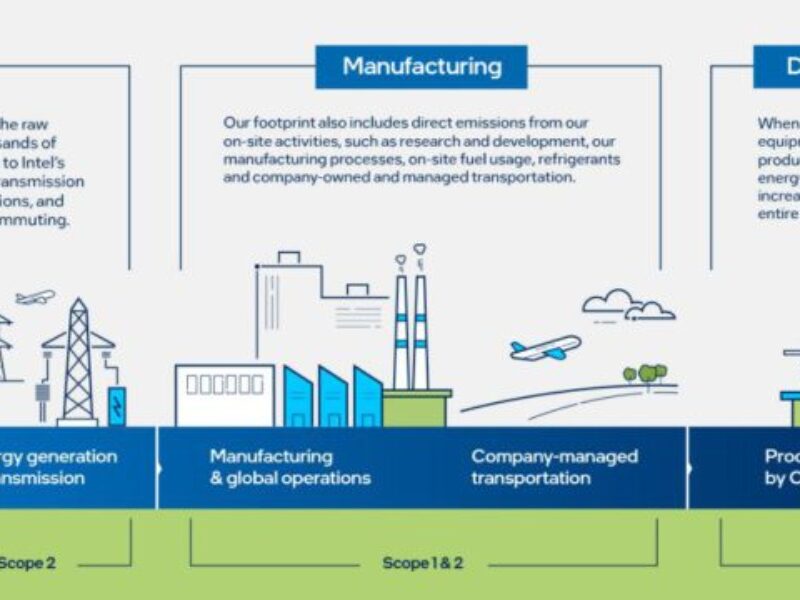
Intel is committing to reach net-zero greenhouse gas emissions across its operations, otherwise known as its Scope 1 and 2 emissions, by 2040. The priority is to actively reduce its emissions, in line with international standards and climate science and has committed to using credible carbon offsets to achieve its goal only if other options are exhausted.
Part of this will be driven by requirements to build energy efficient building in Europe with its plans for fabs in Madgeburg and packaging plants in Italy and France. The company is committing approximately $300 million in energy conservation measures at its facilities to achieve 4 billion cumulative kilowatt hours of energy savings, butth is is over the next 18 years to 2030.
New factories and facilities will meet US Green Building Council LEED program standards, including recently announced investments in Ohio, Germany and Asia
The R&D project is critical to addressing climate impacts throughout its upstream and downstream value chain, also known as Scope 3 emissions. Intel says it is actively engaged with its suppliers to identify areas of improvement to reduce greenhouse gas emissions by 30% by 2030.
Other articles on eeNews Europe
- Europe teams on next generation FD-SOI technology
- Webb space telescope cools to 6K to tackle dark current
- ASML ships EUV scanner to Irish fab
- Telecom operators to provide free coverage for Ukrainian refugees
- Top ten semiconductor companies in 2021
 If you enjoyed this article, you will like the following ones: don't miss them by subscribing to :