Reliability of AI tested in a Causal Chamber
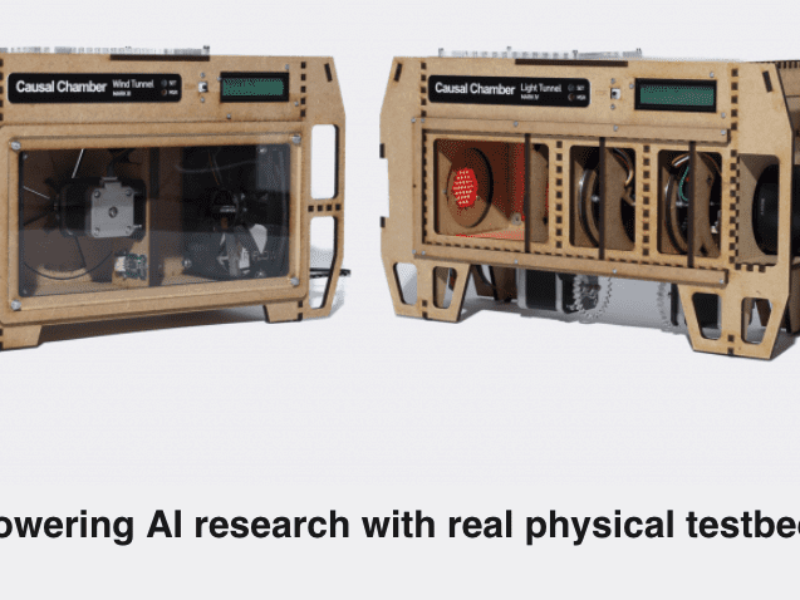
Causal chambers are computer-controlled miniature laboratories and a new way of testing and improving artificial intelligence – developed by mathematician Juan Gamella
An ETH Zurich Report:
Anyone who develops an AI solution sometimes goes on a journey into the unknown. At least at the beginning, researchers and designers do not always know whether their algorithms and AI models will work as expected or whether the AI will ultimately make mistakes. Sometimes, AI applications that work well in theory perform poorly under real-life conditions. In order to gain the trust of users, however, an AI should work reliably and correctly (see ETH Globe Magazine, 18.03.2025). This applies just as much to popular chatbots as it does to AI tools in research.
Any new AI tool has to be tested thoroughly before it is deployed in the real world. However, testing in the real world can be an expensive, or even risky endeavour. For this reason, researchers often test their algorithms in computer simulations of reality. However, since simulations are approximations of reality, testing AI solutions in this way can lead researchers to overestimate an AI’s performance. Writing in Nature Machine Intelligence, ETH mathematician Juan Gamella now presents a new approach that researchers can use to check how reliably and correctly their algorithms and AI models work. An AI model is based on certain assumptions and is trained to learn from data and perform given tasks intelligently. An algorithm comprises the mathematical rules that the AI model follows to process a task … much more
 If you enjoyed this article, you will like the following ones: don't miss them by subscribing to :