Renault lets cars pass toll gates autonomously
In their collaboration, Groupe Renault and Sanef are using the connectivity from car to car and to infrastructure (V2X) developed in the framework of the European SCOOP project. This experimentation, taking place in France, with Renault Autonomous prototypes represents a first step, with the aim to extend cooperation to other countries.
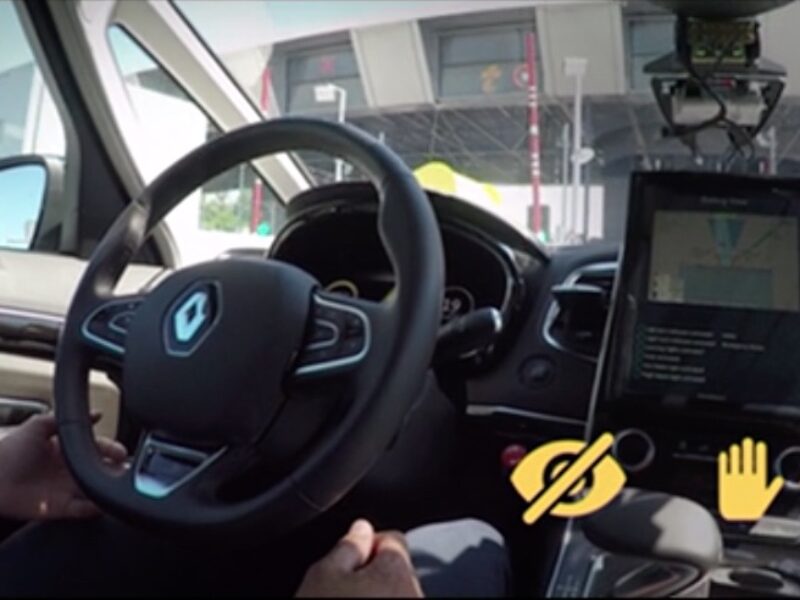
”Autonomous vehicles need premium infrastructures to be developed. That’s the reason why Groupe Renault and Sanef Group are working together on this worldwide innovation. Our goals in terms of road safety and road tech are converging”, said Edouard Fischer, chief technology officer at Sanef Group. A seemingly simple operation such as crossing a toll barrier or a road works zone, represents a major challenge for autonomous cars to provide continuous travel in eyes-off/hands-off mode.
|
The partners launched a pilot project in June 2016, in Normandy along the A13 motorway using the connected infrastructure (V2X) developed by Sanef, to study the approach and crossing of toll barriers and work zones by autonomous drive Renault vehicles. The experimentation in Normandy will continue until mid-2018. During the approach to a toll station, the vehicle receives information about 1 km before the barrier of the toll lanes that are available and compatible with autonomous vehicle driving. Before entering the zone, the vehicle will anticipate its position in the lane and adapt its speed by gradually slowing down according to the speed signs. Approaching such an area is a critical step in the absence of ground marking. To ensure its guidance, the autonomous Renault vehicles use virtual lines derived from a high definition map of the site. Access to the dedicated lane is performed at a speed of less than 30 km/h, while the sensors maintain the car in the center of the lane. |
Within the SCOOP project, Renault and Sanef are already collaborating with other industry partners to conduct large-scale tests on equipment that enables road infrastructure to communicate with cars, and vehicles to communicate with one another – using short range WiFi (ITS G5) allowing communication over (several hundred meters) long distances. These tests take place on different sites in France. Communication units are installed on the road side that exchange information with the equipment on board the car.
Related articles:
Renault buys Intel’s French Embedded Software business
South Korea to create world’s largest test-bed for autonomous driving
Finland’s autonomous cars start communicating
 If you enjoyed this article, you will like the following ones: don't miss them by subscribing to :