Rivian Autonomy Processor moves in-house silicon into the driver’s seat
Rivian has used its first Autonomy & AI Day to outline how the Rivian Autonomy Processor sits at the centre of a more vertically integrated roadmap spanning custom compute, a revised autonomy stack, and broader in-vehicle AI features. The company says the approach is intended to accelerate progress toward higher automation levels while also reshaping the in-car user experience.
For eeNews Europe readers, the Rivian Autonomy Processor is relevant because it highlights how OEMs are increasingly pulling safety-aligned AI compute in-house, with potential implications for chip architectures, validation strategies, and supplier relationships across European vehicle programmes.
Custom silicon and the Gen 3 autonomy computer
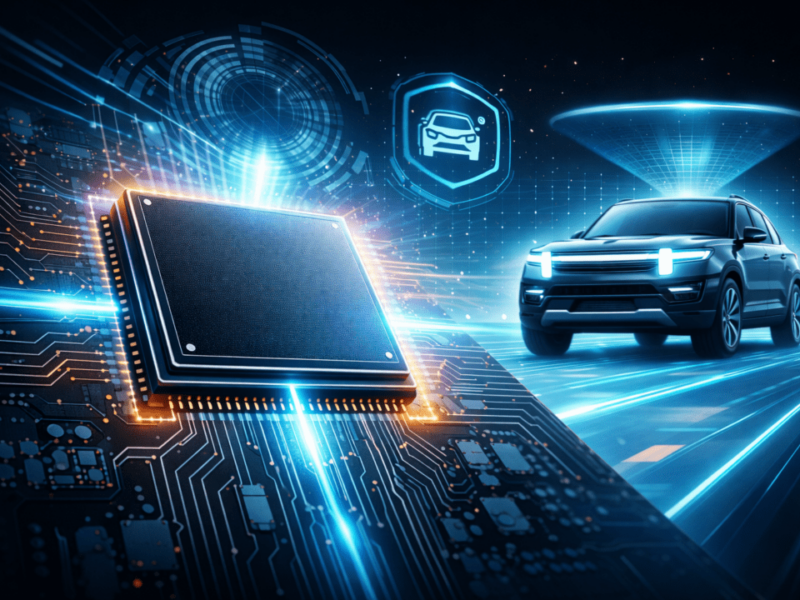
At the core of Rivian’s announcement is a move toward in-house silicon designed for what it calls vision-centric physical AI. The Rivian Autonomy Processor, or RAP1, is described as a custom 5 nm device that integrates processing and memory within a single multi-chip module. Rivian positions the architecture as balancing performance and efficiency while supporting automotive safety requirements.
RAP1 is set to underpin Rivian’s third-generation autonomy computer, the Autonomy Compute Module 3. According to the company, ACM3 delivers 1600 sparse INT8 TOPS and can process around five billion pixels per second. Rivian also points to a low-latency interconnect, branded RivLink, intended to scale compute by linking multiple chips, alongside an internally developed AI compiler and software platform.
Rivian founder and CEO RJ Scaringe framed the shift as a key enabler for higher levels of automation, stating that the updated hardware platform “will enable us to achieve dramatic progress in self-driving” as the company works toward its longer-term Level 4 ambitions.
Autonomy software, LiDAR plans, and subscription packaging
Beyond hardware, Rivian outlined changes to its autonomy software stack, including an end-to-end data pipeline and a so-called Large Driving Model trained using techniques borrowed from large language models. The company highlighted the use of Group-Relative Policy Optimization as a way to extract driving strategies from large datasets, although real-world performance will depend on validation outcomes and deployment scope.
On the sensing side, Rivian confirmed plans to introduce LiDAR on future R2 models as part of a multi-modal sensor strategy. The company positions LiDAR as an additional layer to address difficult detection scenarios, rather than a replacement for vision-based approaches. Rivian says its Gen 3 autonomy hardware, including ACM3 and LiDAR, is currently undergoing validation, with first shipments on R2 vehicles expected toward the end of 2026.
Rivian also announced a paid autonomy offering called Autonomy+, planned for early 2026, priced at either a one-time fee of $2,500 or a monthly subscription. While Rivian suggests the features could improve safety and convenience, the practical impact will likely vary by region, regulatory framework and real-world driving conditions.
 If you enjoyed this article, you will like the following ones: don't miss them by subscribing to :