Sensing highly obscured and non-line-of-sight objects
This device leverages quantum mechanics to detect and inspect highly obscured objects at greater distances and opens new frontiers in remote sensing and beyond
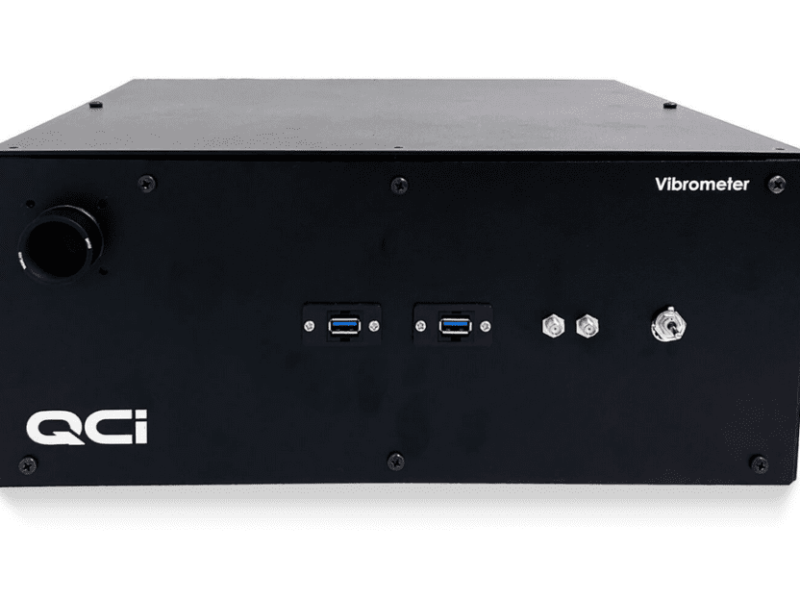
Quantum Computing Inc. announced the release of its first-in-a-series Quantum Photonic Vibrometer (QPV), a proprietary, powerful instrument for remote vibration detection, sensing, and inspection. This device is the first quantum accelerated photonics vibrometer available in the market today and offers significant advancements in sensitivity, speed, and resolution, capable of discerning for the first time, highly obscured and non-line-of-sight objects.
The Quantum Photonic Vibrometer is a proprietary, first of its kind system to leverage the power of single-photon detection—as perfected by our quantum efforts—to offer significant benefits over current vibrometer systems and applications available today.
The first version of the QPV measures the vibration frequency of a remote target by utilizing fast-gated single photon counting to directly detect returning photons whose wavefunctions are dynamically modulated as they are reflected off the target. This is in contrast to optical coherence tomograph or related methods, where a local reference beam and optical interference measurement is needed, thus unable to reach single photon sensitivity.
The QPV eliminates background noise and isolates the specific characteristics of a target object, enables the system to interrogate the material properties of a target at various depths and can provide both surface characteristics as well as volumetric information. Also, counting photons at a megahertz rate, important properties such as material composition and mechanical integrity can be determined within seconds and, depending on detection distance, with microwatt to milliwattoptical power. Working at an eye-safe wavelength, QPV can accurately characterize the vibration spectra of solid or liquid targets with vibration amplitude as small as 100 nanometers. The QPV can remotely sense through obscured media or around the corner where there is no line of sight, implying new capabilities in remote sensing, voice recognition, and ex vivo diagnostics.
 If you enjoyed this article, you will like the following ones: don't miss them by subscribing to :