Sensor for activity tracking and high-g impact measurement
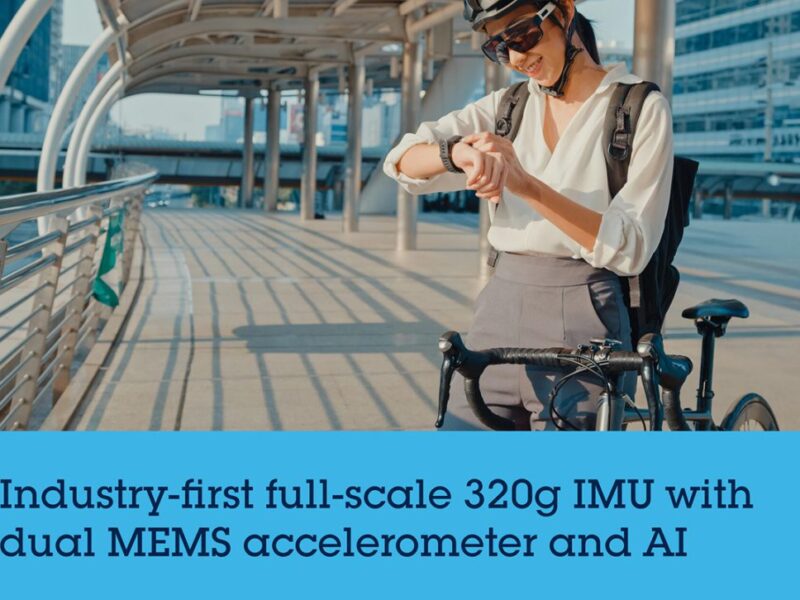
STMicroelectronics has unveiled a sensor that combines an inertial measurement unit (IMU) with embedded AI and is optimised for activity tracking and high-impact measurement in a single, compact package.
The LSM6DSV320X sensor is an industry first in a regular-sized module, measuring 3 x 2.5 mm, with embedded AI processing that enables continuous registration of movements and impacts. An innovative dual-accelerometer device ensures high accuracy for activity tracking up to 16g and impact detection up to 320g. The two accelerometers are designed for coexistence and optimal performance using advanced techniques unique to ST. One of these accelerometers is optimised for best resolution in activity tracking, with a maximum range of ±16g. The other accelerometer can measure up to ±320g to quantify severe shocks, such as collisions or high-impact events.
In total, the LSM6DSV320X integrates three MEMS sensors, including the ±16g and ±320g accelerometers and a MEMS gyroscope with a ±4000dps range. The sensors are fully synchronized, making the modules easy to use and helping to simplify application development.
“We continue to unleash more and more of the potential in our cutting-edge AI MEMS sensors to enhance the performance and energy efficiency of today’s leading smart applications,” said Simone Ferri, APMS Group VP, MEMS Sub-Group General Manager at STMicroelectronics. “Our new inertial module with unique dual-sensing capability enables smarter interactions and brings greater flexibility and precision to devices and applications such as smartphones, wearables, smart tags, asset monitors, event data recorders, and larger infrastructure.”
An embedded AI processor with a machine learning core (MLC) handles inference directly in the sensor, thereby lowering system power consumption and enhancing application performance.
In addition to the MLC, which handles energy-efficient context awareness, the LSM6DSV320X integrates a finite state machine (FSM) that facilitates motion tracking within the module. The digital circuitry also includes Sensor Fusion Low-Power (SFLP) technology developed by ST for spatial orientation.
Further, the LSM6DSV320X features adaptive self-configuration (ASC) to optimise power consumption. Sensors with ASC can automatically adjust their settings in real-time upon detecting a specific motion pattern or signal from the MLC, eliminating the need for intervention from the host processor.
By covering a wide sensing range with high accuracy in a tiny device, the new AI MEMS sensor will enable consumer and IoT devices to offer even more features while maintaining a stylish or wearable form factor. An activity tracker can monitor performance within normal ranges and measure high impacts for safety in contact sports, enhancing value for consumers and professional/semi-pro athletes. Other consumer-market opportunities include gaming controllers, which enhance the user experience by detecting rapid movements and impacts, as well as smart tags for attaching to items and recording movement, vibrations, and shocks to ensure their safety, security, and integrity.
The sensor will also enable new generations of smart devices for sectors such as consumer healthcare and industrial safety. Potential applications include personal protection devices for workers in hazardous environments and assessing the severity of falls or impacts. Other uses include equipment for accurately assessing the health of structures such as buildings and bridges.
To facilitate tracking high-intensity impacts while maximising accuracy for low-g events, ST has also created and patented the Motion XLF software library, which combines data from both low-g and high-g accelerometers. Engineering teams can freely use the software in their designs using the X-CUBE-MEMS1 package. ST also provides free of charge, graphical design tools that help evaluate, configure, and test the LSM6DSV320X sensor and embedded AI, as well as connect projects with STM32 applications. These include MEMS Studio, part of the ST Edge AI Suite, and ST AIoT Craft, the web-based environment with tools for developing and provisioning node-to-cloud AIoT (Artificial Intelligence of Things) projects.
 If you enjoyed this article, you will like the following ones: don't miss them by subscribing to :