Small air-cooled LED UV source boosts curing performance
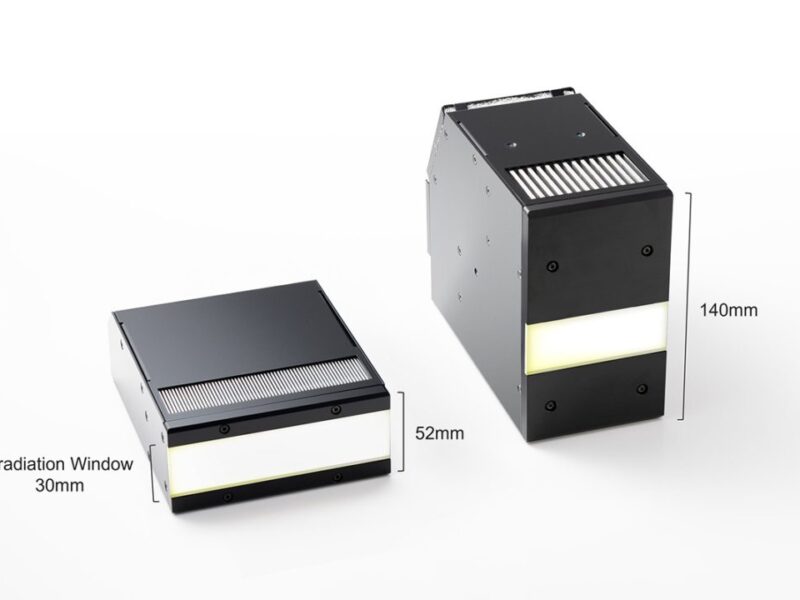
Kyocera Corporation has developed a new air-cooled, UV LED light source that delivers high curing performance for applications such as ink, resin curing and adhesion in a compact form factor.
UV-curing light sources have encountered significant challenges, such as reducing power consumption to lower CO2 emissions, decreasing ozone emissions, and adhering to mercury regulations. Furthermore, there is an increasing demand for space-efficient manufacturing, which has resulted in a need for more compact light sources with enhanced curing performance.
The G7A Series UV LED light sources from Kyocera have a low environmental impact and utilise an air-cooled system that does not require cooling water, even at high output. Additional equipment, such as a water-cooling system, is unnecessary, enabling a more compact installation.
The UV source achieves a high irradiance of 20 W/cm², the highest in its class among air-cooled UV LED light sources. Energy efficiency is maximised through effective heat dissipation via a proprietary ceramic substrate and a module design that includes a heat sink. Additionally, by achieving a total dose of 400 mJ/cm² at 50 m/min, which is a key indicator of curing performance, Kyocera has achieved high-speed curing performance comparable to that of water-cooled UV LED light sources, all within a compact design.
In comparison to the conventional high-output G5H Series, the G7A Series has a footprint that is 62 percent smaller, with its height reduced by 10 percent. Measuring 120 x 52 x 151 mm, it is among the most compact UV LED light sources available, offering equivalent optical performance. The G7A features a 30 mm irradiation window, which allows for space savings while maintaining high curing performance.
The G7A features a scalable structure in 120 mm increments, allowing the irradiation width to be adjusted from a minimum of 120 mm to a maximum of 2,400 mm by connecting multiple light source units. This allows flexible customisation of the irradiation width to suit a wide variety of printed materials. Furthermore, the system can connect to external devices via serial communication, permitting fine adjustments to the LED irradiation width in increments of approximately 30 mm.
Serial communications enable monitoring of LED temperature, current, fan operation time, and accumulated lighting hours. It can also detect lighting and system errors as well as provide notifications for filter replacement and LED lifespan, ensuring stable system operation.
 If you enjoyed this article, you will like the following ones: don't miss them by subscribing to :