
Software-designed instruments redefine oscilloscopes, signal analysers and high-speed serial test
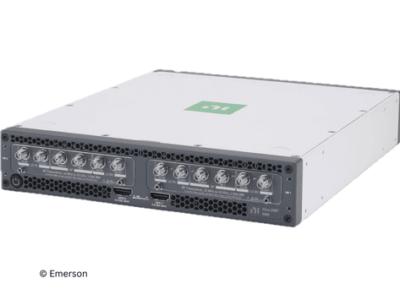
Two years ago, NI introduced the first software-designed instrument, the vector signal transceiver. By replacing traditional vendor-defined instruments with NI software-designed instrumentation, Qualcomm Atheros improved test speeds by more than 200X and Hittite Microwave reduced test times by more than 30X. The latest software-designed instruments address automated test and research applications across wireless and mobile devices, semiconductor, automotive and aerospace/defence industries, and include:
- 14-bit, 250 MS/s, 300 MHz, 8-channel oscilloscope;
- 26.5 GHz high-performance RF vector signal analyzer;
- 12-bit, 2 GS/s, 2 GHz intermediate frequency digitizer;
- 12.5 Gb/s, 8 TX/8 RX lane high-speed serial instrument.
“Providing a user-programmable FPGA can lead to astounding benefits for the customer, enabling them to drill down into the instrument and change the performance drastically,” said Prathima Bommakanti, Industry Analyst for Measurement and Instrumentation at Frost & Sullivan. “With this new class of instrumentation, users are able to turn the instrument into whatever they need, a paradigm shift in an industry in which products have essentially been defined by the vendor as opposed to the customer.”
NI software-designed instruments contain a user-programmable FPGA customised with the familiar graphical data flow of LabVIEW system design software, eliminating the need for specialised languages such as VHDL and Verilog, costly digital design experts or payments to instrument vendors each time a customisation is needed.
“Requirements for RF test are constantly changing and quickly emerging,” said Christian Pfefferer, Global Test Engineer for Valeo. “User-programmable FPGAs provide the flexibility needed to keep up with the expanding requirements in RF test, helping us meet our current RF test specifications for spectrum measurements, but also making us well prepared to address future needs.”
 If you enjoyed this article, you will like the following ones: don't miss them by subscribing to :