Spectrometric ‘pen’ identifies cancer in seconds
The tool, called the MasSpec Pen, is able to deliver results in about 10 seconds, which is more than 150 times as fast as existing technology. By providing surgeons such precise and timely diagnostic information about what tissues to cut or preserve, the tool could help improve treatment and reduce the chances of cancer recurrence.
“If you talk to cancer patients after surgery, one of the first things many will say is ‘I hope the surgeon got all the cancer out,’” says Livia Schiavinato Eberlin, an assistant professor of chemistry at UT Austin who designed the study and led the team. “Our technology could vastly improve the odds that surgeons really do remove every last trace of cancer during surgery.”
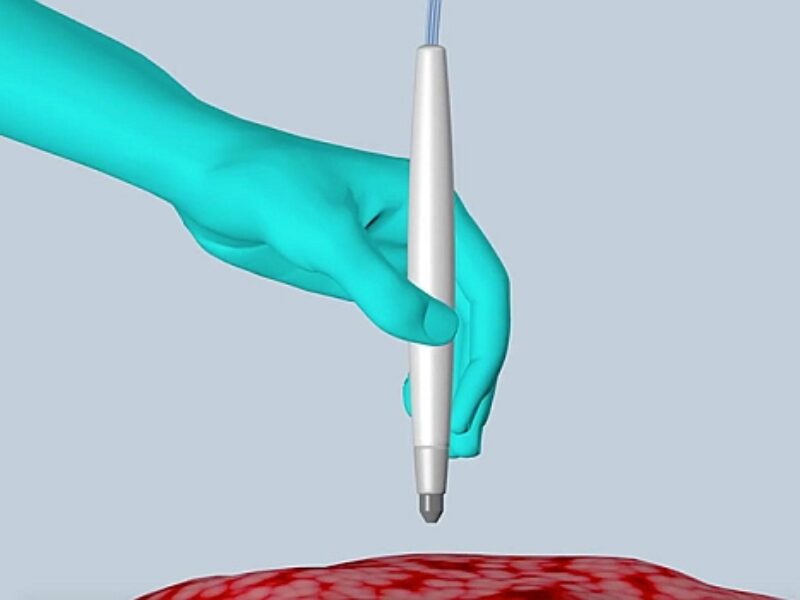
The instrument works by using mass spectrometry to identify metabolites and other biomarkers in living cells – both healthy and cancerous – that act as fingerprints. To operate it, a physician simply holds the plastic tip of the pen against a patient’s tissue and triggers the automated analysis using a foot pedal.
The pen then releases a drop of water onto the tissue resulting in small molecules migrating into the water. The water sample is then driven into a mass spectrometer that detects thousands of molecules as a molecular fingerprint. When the MasSpec Pen completes the analysis, the words “Normal” or “Cancer” automatically appear on a computer screen.
“Because the metabolites in cancer and normal cells are so different, we extract and analyze them with the MasSpec Pen to obtain a molecular fingerprint of the tissue,” says Eberlin. “What is incredible is that through this simple and gentle chemical process, the MasSpec Pen rapidly provides diagnostic molecular information without causing tissue damage.”
In tests performed on human samples, say the researchers, the device was more than 96 percent accurate for cancer diagnosis. The pen was also demonstrated to accurately diagnose cancer in live, tumor-bearing mice during surgery without causing any observable tissue harm or stress to the animals.
The device is currently awaiting full approval and the researchers have filed U.S. patent applications. For more, see “Nondestructive tissue analysis for ex vivo and in vivo cancer diagnosis using a handheld mass spectrometry system.”
Related articles:
Micro-spectrometer fits smartphones, wearables
AI speeds up precision medicine, says IBM Watson study
Analog, Consumer Physics team to enable material analysis anywhere
Portable breath sensor detects lifestyle diseases
 If you enjoyed this article, you will like the following ones: don't miss them by subscribing to :