Spectrum adds direct synthesis of 20 sine waves to AWG cards
 Cette publication existe aussi en Français
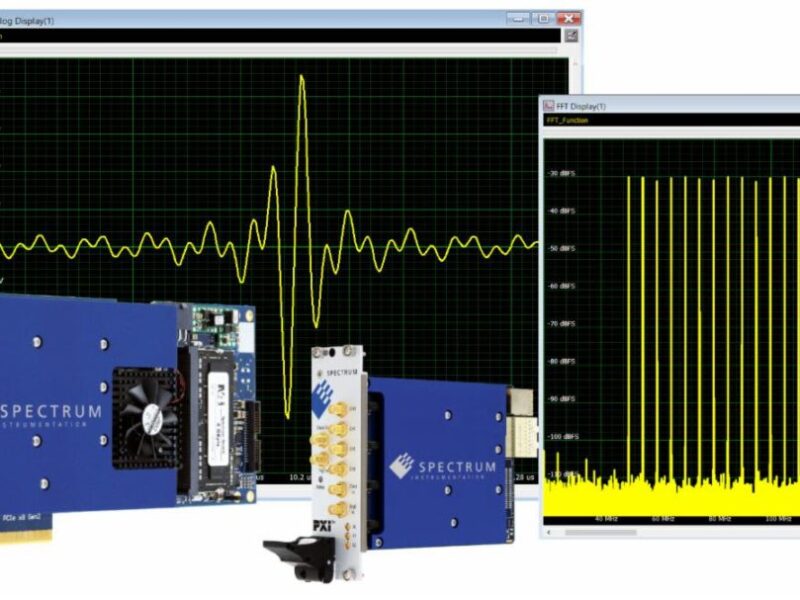
Spectrum Instrumentation has developed a firmware option for its 16bit Arbitrary Waveform Generator (AWG) cards to control 20 independent sine waves up to 400 MHz from one generator channel.
The Direct Digital Synthesis (DDS) new option allows users to define 23 DDS cores per AWG card, supporting sampling rates up to 1.25 GS/s and bandwidths up to 400 MHz.
Each DDS core (sine wave) can be programmed for frequency, amplitude, phase, frequency slope and amplitude slope. This enables, for example, the control of lasers through AODs and AOMs, as often used in quantum experiments, with just a few simple commands – instead of making large data array calculations. The DDS output can be synchronized with external trigger events or by a programmable timer with resolution of 6.4 ns.
- Digitizer and AWG products get digital pulse generator
- Portable AWG allows signal-generation for up to 16 channels
The DDS generates arbitrary periodic sine waves from a single, fixed-frequency reference clock and is based on the principle of adding multiple ‘DDS cores’ to generate a multi-carrier (multi-tone) signal with each carrier having its own well-defined frequency, amplitude and phase.
The ability to switch between the normal AWG mode (which generates waveforms out of pre-programmed data) and the DDS mode (which needs only a few commands to generate sine wave carriers), means the AWG cards can be adapted to many applications.
In DDS-mode, the AWG acts as a base for the multi-tone DDS. The units built-in 4 GByte of memory and fast DMA transfer mode then allows the streaming of DDS commands at a rate as high as 10 million commands per second. This unique capability provides the flexibility to perform user-defined slopes (e.g. s-shaped) as well as various modulation types (e.g. FM and AM) with simple, easy-to-use, DDS commands.
The DDS option provides an easy and programmable way for users to produce trains of waveforms, frequency sweeps or finely tuneable references of various frequencies and profiles. Applications that require the fast frequency switching and fine frequency tuning that DDS offers are widespread. They can be found in industrial, medical, and imaging systems, network analysis or even communication technology, where data is encoded using phase and frequency modulation on a carrier.
The DDS option is available now for the full range of M4i.66xx PCIe cards, M4x.66xx PXIe modules, portable LXI/Ethernet DN2.66x units and multi-channel desktop LXI/Ethernet DN6.66xx products. By simply performing a firmware update, all previously purchased 66xx series products can be equipped with the new firmware option. Programming can be done using the existing driver SDKs that are included in the delivery. Examples are available for Python, C++, MATLAB, LabVIEW and many more. The option is available now.
 If you enjoyed this article, you will like the following ones: don't miss them by subscribing to :