TDK spins out AI processor for smart glasses
TDK has spun out a new company to provide ultra-low power AI for reference designs of smart glasses.
TDK AI Sight comes from the acquisition of SoftEye last year, which was developing a low power AI processor and image sensor.
“AIsight is a platform where the hardware is the anchor point,” Te-Won Lee, CEO of TDK-AI Sight tells eeNews Europe. “It’s a custom chip that combines with camera sensors to communicate.”
“At Softeye we were focussed on linking AI to the user wearing the glasses who wants to convey what they are seeing in an always on fashion, in a fluent dialogue, as if the AI is on your shoulder. The idea was to use custom sensors and a custom chip with the battery life for a full day.”
The SED0112 digital signal processor (DSP) takes the output from the camera sensor, tracks where the user is looking and identifies what they are looking at. The chip is part of a planned platform family of DSPs integrating a microcontroller, state machine, and custom Convolutional Neural Networks (CNN) engine.
The built-in CNN is specially optimized for eye gaze, only processing the image when it is not moving. This cuts the power consumption considerably, says Lee.
“The AI chip is a processor optimised for vision functions and the idea is that it estimates where the eyes are looking it runs certain algorithms that mimic human vision functions,” he said. “We are only looking in high resolution at a certain area, that’s the spatial component, and only at certain times, that’s the temporal aspect for what the user is looking at, when the eye is resting rather than moving, that’s how you get the low power,” he said.
“A CNN is used for the detection and you can time it so that it is a function of an input that is determined by the custom sensors so it’s not running all the time. This allows our platform with the vision system to run below 10mW on average with 150mA battery and that gives 22 hours of operation. Other elements will be added and those will take more power,” he said.
“What we are intending to do is bring the technologies from TDK to build reference designs,” said Lee. We have around 100 engineers and we are growing the team but the reason we can stay small and nimble is we can leverage the technologies being developed within TDK.”
“TDK is not building glasses for consumers but we are working with OEMs that are good at building glasses in a very simple fashion, they can take the platform or take certain elements. “It’s going from components to a systems company, it’s moving up the stack “
“Physical AI represents a strategic domain within TDK’s contribution to the AI ecosystem and enables technologies across devices, systems, and infrastructure to perceive, understand, and interact with the physical world by processing data from a variety of TDK sensors and technologies. This capability leads to autonomous robots, enhanced consumer devices, and intelligent manufacturing that will interact directly with humans and physical processes to sense user context and deliver personalized AI assistance. TDK AIsight will now be part of our portfolio to move this forward,” said Noboru Saito, President and CEO of TDK.
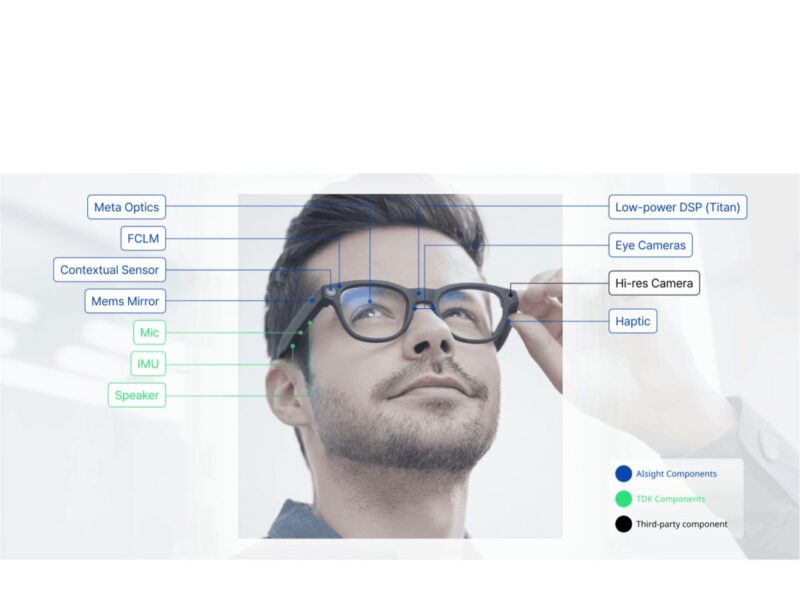
TDK aims to sell a range of other components and sub-systems alongside the AI Sight technology, including an inertial measurement unit (IMU) from TDK InvenSense that tells the system where the user is looking.
“This platform is an anchor to add functionalities with TDK components into the glasses,” said Lee. “IMU is one of them, MEMS microphones are another for the audio subsystem, and there are also piezo elements for haptics. One of the technically challenging is the display subsystem for power consumption, and on the display side TDK has a laser display engine, switching from microLED to laser based scanning FCLM full colour laser module with a MEMS mirror,” he said.
“The IMU is considered power hungry as the gyro has to be driven but one of the advantages of InvenSense is the low power gyro,” says Song Li, product marketing director for motion products at Invensense.“The 6 axis IMU has a current draw of 420uA which with a 1.8V supply is 700uW, and there is a low power mode with 280uA with less than 0.5mW. This has a two balanced gyroscopes on the wafer as a differential pair to reject vibrations in smart glasses.”
The reference design for smart glasses is on display at the CES 2026 exhibition in Las Vegas this week. “We are working with OEMs already and sampling for glasses that will come out in the market by the end of 2026,” said Lee.
 If you enjoyed this article, you will like the following ones: don't miss them by subscribing to :