
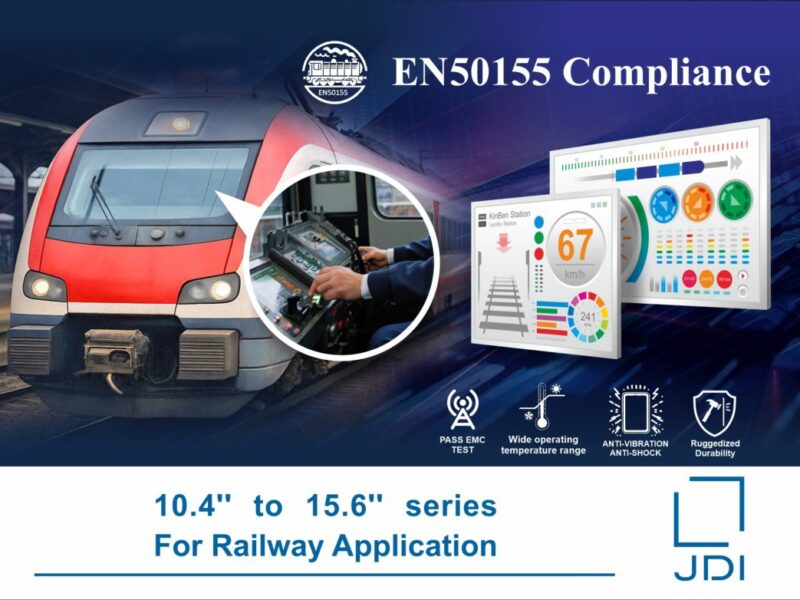
TFT display modules target EN50155 railway compliance
JDIT-K (JDI Taiwan Kaohsiung) has released a family of TFT display modules designed to meet the EN50155 OT3 standard for railway and mass transit applications. The modules offer a combination of wide temperature tolerance, mechanical durability, and electromagnetic compatibility to support display needs in increasingly digitalised rolling stock.
For eeNews Europe readers working on embedded displays, rail-certified electronics, or transportation infrastructure, this announcement may be relevant for meeting tough compliance requirements without compromising visibility or long-term reliability.
Built to withstand rail-specific electrical and environmental stress
The EN50155:2017 standard, equivalent to IEC 60571, defines the performance requirements for electronic equipment used in railway environments. It covers conditions such as thermal variation, humidity, vibration, shock, and EMC. JDIT-K’s EN50155 OT3-compliant display range includes models from 10.4″ to 15.6″ with brightness ratings up to 1500 cd/m² and temperature ratings from –40°C to +90°C. All modules were tested for 6.8G vibration, 150G shock, and electrostatic discharge up to 15 kV contact.
“JDIT-K EN50155 OT3 compliance displays have been designed and developed to provide robust electrical, mechanical and environmental characteristics that are highly resistant to vibration, shock, electro-static discharge and temperature variation, even exceeding the EN50155 standard test criteria,” said Benson Huang, marketing manager at JDIT-K. “With our products achieving EN50155 compliance, we can guarantee the long-term ruggedness and reliability of display modules for our end customers.”
JDIT-K also notes previous supply engagements for EN50155-compliant modules in both Europe and Asia, supporting control interfaces, dashboards, and information displays.
Engineering features that address railway certification demands
To meet EN50155 OT3, the modules incorporate several functional layers that aim to protect system performance under field conditions. These include:
-
thermal resilience across wide and fluctuating temperatures without derating
-
mechanical stability against continuous vibration and periodic shocks
-
ingress protection using sealed enclosures to guard against moisture and dust
-
electromagnetic compatibility, tested to CISPR32 and ESD tolerance standards
-
power fluctuation management, ensuring the modules remain operational under voltage variation typical of on-board systems
While some modules are designed for higher contrast ratios or higher resolution (e.g., 1920×1080), the full range shares the same mechanical and electrical compliance characteristics. This allows railway equipment manufacturers to scale across use cases with consistent qualification status.
As railway systems continue their transition to digital controls and passenger information platforms, display modules that meet EN50155 criteria are likely to play a growing role in ensuring equipment uptime and passenger safety.
For full product specifications and documentation, visit: www.jditk-j-display.com
 If you enjoyed this article, you will like the following ones: don't miss them by subscribing to :