
The future of edge AI: scaling intelligence from metal to cloud
Edge AI is reshaping how intelligence reaches the real world. Pete Bernard, Executive Director of the EDGE AI FOUNDATION, discusses how edge AI can solve global challenges in accessible ways, and he touches on what it will take to empower the next million innovators at the edge.
Elektor: What motivated the rebrand from tinyML to the EDGE AI FOUNDATION, and what does it say about where the ecosystem is headed?
Pete Bernard: We followed the community’s lead — the tinyML Foundation was started back in 2018 and was instrumental in the early days in figuring out how to run AI models in these very resource-constrained environments. But, our community conversations were evolving beyond the original tinyML constraints into broader conversations and research around AI vision, generative AI, physical AI, etc., and connecting the cloud to the edge. So, a rebrand and a rethink on the scope of the org were needed. It’s been well-received, and we now have a much more diverse and growing edge AI community that spans metal to cloud and pre-seed to big tech.
Elektor: You see applications across healthcare, manufacturing, energy, and beyond. Which industries are you most excited about right now, and why?
Bernard: There’s tremendous upside when you can enable endpoints with intelligence. Some are obvious optimizations in process, in yields, and in safety, but we’re also seeing combinations of AI models working together, such as VLMs (visual language models) paired with sensor networks to bring language intelligence and agentic AI to the real world. Imagine if you could walk into a hospital room and ask how the patient is doing and get a readout in your own language, or ask a piece of equipment how it’s doing and it can tell you what maintenance may be needed, or a brain implant can tune itself to help a Parkinson’s patient. It’s these novel combinations that are really fascinating, and I think it’s just the beginning.
Elektor: The Foundation has touched thousands of students globally. How do you see education shaping the next generation of edge AI innovators, especially in emerging markets?
Bernard: We have over 100k students around the world learning edge AI through our scholarship fund that underwrites educational programs in the developing south, through our support of an open-source curriculum for universities and schools, as well as our EDGE AI Challenges and Grant programs. As an example, we underwrote a multi-week program in Malawi in March to bring edge AI to hundreds of educators and students, with hands-on labs and instructions on the open-source curriculum that we support. We’ll be doing the same in Colombia in late September. The big force multiplier for us is to educate and empower educators to go out and teach this themselves in engineering programs and schools. We are also launching the EDGE AI Certification program this fall to certify your knowledge level in edge AI in an accessible and product-neutral approach.
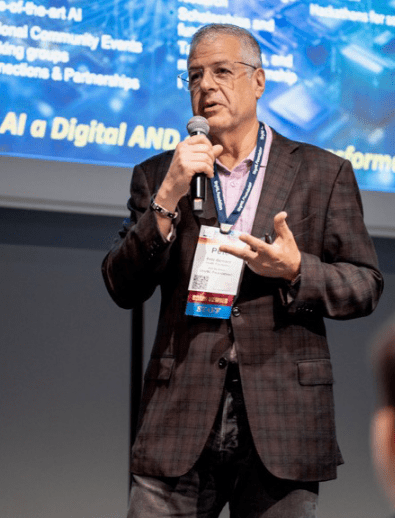
Pete Bernard (Source: EDGE AI FOUNDATION)
Elektor: You’ve been involved in AI governance discussions with organizations such as the World Economic Forum. What’s most urgent right now in terms of policy around AI at the edge?
Bernard: Right now, we’re all running as fast as we can, and frankly we’re lacking transparency (where did this data come from?) and missing areas such as safety certification. Once you get agentic AI out there in physical AI, you start creating some amazing but potentially super-risky scenarios. Two of my areas of focus right now are safety guardrails and best practices or for real-world agentic AI. For example, what are best practices to “hire” an AI agent, what are the protocols for moving data between the edge and the cloud and other systems, and what are the boundaries by which agents can operate at the edge or require human-in-the-loop efforts?
Elektor: How can edge AI avoid becoming a “luxury technology” and instead become a tool for solving critical challenges in underserved regions?
Bernard: The good news is that edge AI has always been about efficiency — efficiency of cost, of power, of size — so it really is the simplest and cheapest way to implement AI in the real world. We see it implemented locally in agriculture, water systems, safety and security scenarios, where a nuclear-powered data center or connectivity is not required. And the low-power aspect makes many systems self-powered and very sustainable.
Elektor: What do you see driving the next wave of innovation and adoption with edge AI — developments in hardware or software? Or is increased awareness the next piece of the puzzle?
Bernard: We have been crushing it as an industry on the semiconductor side — acceleration architectures, high-performance memory, new processes for low power — but I think the next wave will be very software-driven — with better tools, better portability, and easier and more secure MLOps and workload orchestration. We need to make it easy to leverage cloud training and edge inference, to strengthen edge learning, to move models between platforms, to manage, update, and replace AI models in the field that may drift, and to view edge resources just like any other cloud resource, using the same tools and approaches for virtualized cloud workloads. Ultimately, these all stack up to repeatable and commercialized solutions that are easier to deploy and scale and get the business outcomes that are needed.
Elektor: Are there any use cases you’ve come across that illustrate the unexpected, human side of edge AI — something beyond efficiency gains?
Bernard: Sometimes we take for granted things such as clean water and abundant food, but for many parts of the world that is a common struggle, so, using edge in these scenarios has real immediate impact. I also think edge AI that impacts environmental protection (monitoring who is doing bad things in the woods) and scenarios to help ageing in place are scenario examples that everyone can grok as real and needed.
Elektor: If you think five years out, what will success look like for the EDGE AI FOUNDATION in terms of impact on technology, people, and the planet?
Bernard: From an education standpoint, we want to empower a million minds at the edge of AI. That’s very doable if we keep growing our scholarship fund and educational programs. For edge AI advocacy, we want to make edge AI the “default design choice” for most AI scenarios across manufacturing, industrial, automotive, retail, hospitality, agriculture, power, maritime, and more. That will require real collaboration across our community, but we need to bring the AI to the data, not send the data to the AI (in the cloud). It just makes sense.
Editor’s Note: This interview first appeared in the 2025 Edge Impulse guest-edited edition of Elektor. eeNews Europe is an Elektor International Media publication.
 If you enjoyed this article, you will like the following ones: don't miss them by subscribing to :