Nvidia adds GenAI to 2nm computational lithography
TSMC and Synopsys are going into production with a computational lithography platform developed by Nvidia to accelerate chip making.
TSMC and Synopsys have integrated the Nvidia cuLitho libraries into their software, manufacturing processes and systems to speed chip fabrication and support the Blackwell architecture GPUs to 2nm process technologies.
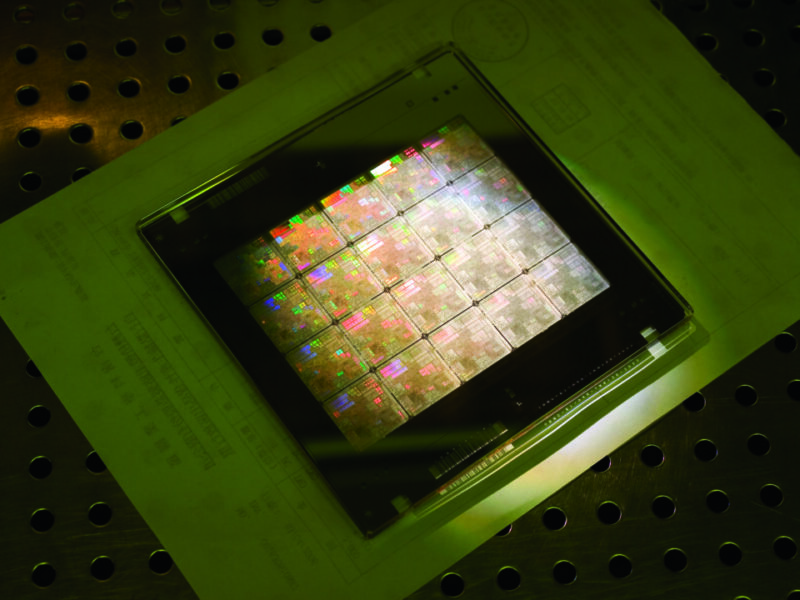
Computational lithography uses AI techniques to improve the quality and resolution of mask sets for the most complex chips such as Blackwell, which is limited by the size of the reticle.
NVvidia has also developed generative AI algorithms that enhance cuLitho, a library for GPU-accelerated computational lithography, dramatically improving the semiconductor manufacturing process over current CPU-based methods.
In testing cuLitho on shared workflows, the companies jointly realized a 45x speedup of curvilinear flows and a nearly 60x improvement on more traditional Manhattan-style flows. These two types of flows differ — with curvilinear the mask shapes are represented by curves, while Manhattan mask shapes are constrained to be either horizontal or vertical.
A typical mask set for a chip — a key step in its production — could take 30 million or more hours of CPU compute time, necessitating large data centres within semiconductor foundries. 350 Nvidia H100 systems can now replace 40,000 CPU systems, accelerating production time, while reducing costs, space and power. That would be further reduced to under 100 B100 Blackwell systems in the future.
CEO interview: AI creates step change for lithography. Aki Fujimura, D2S
“Computational lithography is a cornerstone of chip manufacturing,” said Jensen Huang, founder and CEO of Nvidia. “Our work on cuLitho, in partnership with TSMC and Synopsys, applies accelerated computing and generative AI to open new frontiers for semiconductor scaling.”
“Our work to integrate GPU-accelerated computing in the TSMC workflow has resulted in great leaps in performance, dramatic throughput improvement, shortened cycle time and reduced power requirements,” said Dr. C.C. Wei, CEO of TSMC. “We are moving cuLitho into production at TSMC, leveraging this computational lithography technology to drive a critical component of semiconductor scaling.”
“For more than two decades Synopsys Proteus mask synthesis software products have been the production-proven choice for accelerating computational lithography — the most demanding workload in semiconductor manufacturing,” said Sassine Ghazi, president and CEO of Synopsys. “With the move to advanced nodes, computational lithography has dramatically increased in complexity and compute cost. Our collaboration with TSMC and NVIDIA is critical to enabling angstrom-level scaling as we pioneer advanced technologies to reduce turnaround time by orders of magnitude through the power of accelerated computing.”
Synopsys has developed a tool called Prometheus for optical proximity correction running on the NVIDIA cuLitho software library which significantly speeds computational workloads compared to current CPU-based methods.
With Proteus mask synthesis products, manufacturers like TSMC can boost precision, efficiency and speed in proximity correction, model building for correction, and analyzing proximity effects on corrected and uncorrected IC layout patterns, revolutionizing the chip fabrication process.
ASML, TSMC, Synopsys join Nvidia for computation lithography
The generative AI workflow halves the time on top of the computing efficiencies enabled through cuLitho. The application of generative AI enables creation of a near-perfect inverse mask or inverse solution to account for diffraction of light. The final mask is then derived by traditional and physically rigorous methods, speeding up the overall optical proximity correction (OPC) process by a factor of two.
Many changes in the fab process currently necessitate a revision in OPC, driving up the amount of compute required and creating bottlenecks in the fab development cycle. These costs and bottlenecks are alleviated with the accelerated computing cuLitho provides and generative AI, enabling fabs to allocate available compute capacity and engineering bandwidth to design more novel solutions in development of new technologies for 2nm and beyond.
www.tsmc.com; www.synopsys.com; www.nvidia.com
 If you enjoyed this article, you will like the following ones: don't miss them by subscribing to :