
MENU

Transistor made of wood – BioElectronics Research

Transistor made of wood – BioElectronics Research

Technology News |
By Wisse Hettinga


Electrical current modulation in wood electrochemical transistor

The research is focussing on an approach to preparing conductive wood (CW), in which the electrical conductivity can be modulated using an external potential. This has resulted in a transistor where all three terminals are made of conductive wood and which can be operated continuously at the selected conductivity without being limited by, e.g., saturation effects. The researchers expect this device and concept will be a stepping stone for the development of wood-based electrical components.

The research is performed by Van Chinh Tran, Gabriella G. Mastantuoni, Marzieh Zabihipour and Isak Engquist
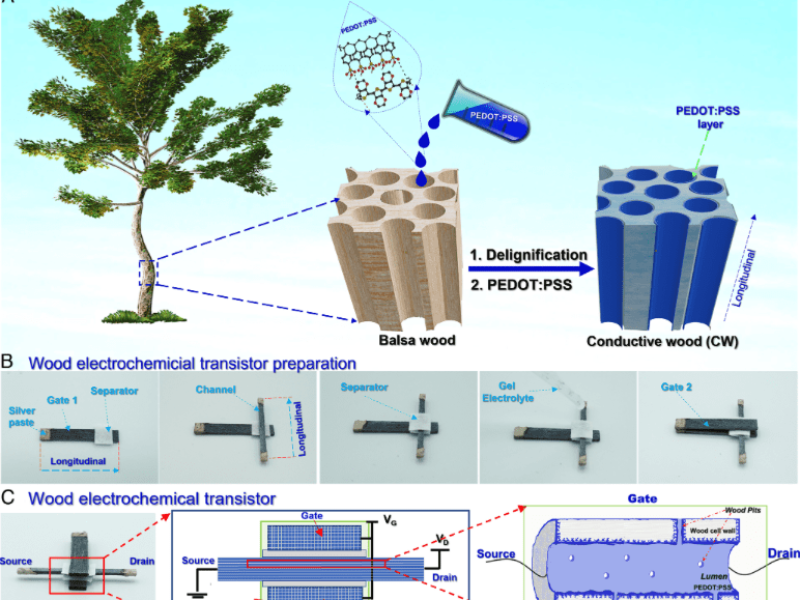
In the report  the team mentions a wood electrochemical transistor (WECT) where all three electrodes are fully made of conductive wood (CW). The CW is prepared using a two-step strategy of wood delignification followed by wood amalgamation with a mixed electron-ion conducting polymer, poly(3,4-ethylenedioxythiophene)–polystyrene sulfonate (PEDOT:PSS).
 

The schematic diagrams of (A) conductive wood preparation and (B) the wood electrochemical transistor fabrication processes. (C) From Left to Right: Front view photograph of a WECT, front view of the WECT configuration, and section of a wood fiber (conceptual view of transistor’s channel zoom-in) showing PEDOT:PSS-coated cell wall and electrolyte-transporting lumen.

 
The modified wood has an electrical conductivity of up to 69 Sm−1 induced by the formation of PEDOT:PSS microstructures inside the wood 3D scaffold. CW is then used to fabricate the WECT, which is capable of modulating an electrical current in a porous and thick transistor channel (1 mm) with an on/off ratio of 50. The device shows a good response to gate voltage modulation and exhibits dynamic switching properties similar to those of an organic electrochemical transistor. This wood-based device and the proposed working principle demonstrate the possibility to incorporate active electronic functionality into the wood, suggesting different types of bio-based electronic devices.
 
The researchers expect that in view of the large interest in exploratory research concerning bioelectronics, bio-based electronics, and plant electronics, this device and its working principle might be a stepping stone toward different applications in those fields.
 
 
The research was financially supported by the Wallenberg Wood Science Center (Knut and Alice Wallenberg Foundation) and the Karl-Erik Önnesjö Foundation. The team also acknowledges the support from Treesearch, a collaboration platform for Swedish forest industrial research.
If you enjoyed this article, you will like the following ones: don't miss them by subscribing to :    eeNews on Google News

Share:

Linked Articles
10s