Ultra-thin lightsails for space exploration – inch by inch
Nanotechnology-based lightsails that could support future advances in space exploration and experimental physics
A TU Delft and Brown University report:
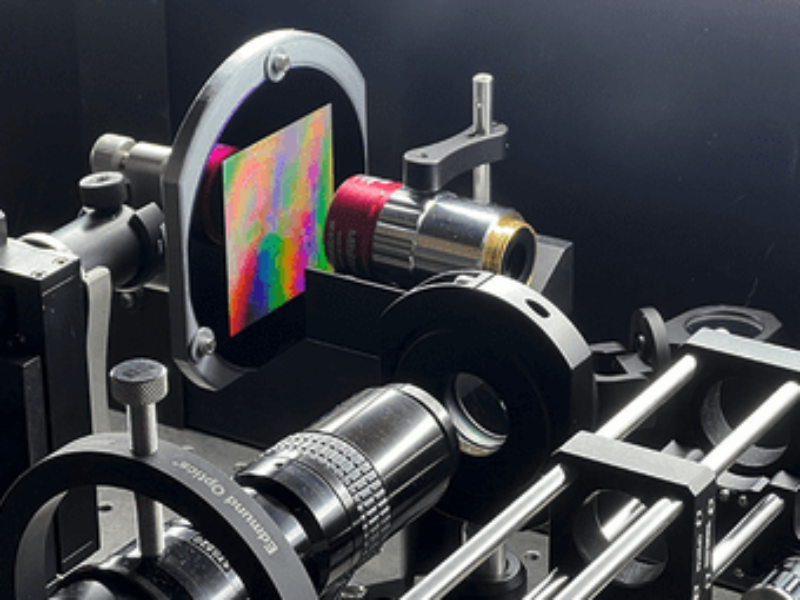
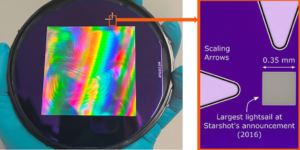
Lightsails are ultra-thin, reflective structures that use laser-driven radiation pressure to propel spacecraft at high speeds. Unlike conventional nanotechnology, which miniaturizes devices in all dimensions, lightsails follow a different approach. They are nanoscale in thickness—about 1/1000th the thickness of a human hair—but can extend to sheets with large dimensions.
Fabricating a lightsail as envisioned for the Starshot Breakthrough Initiative would traditionally take 15 years, mainly because it is covered in billions of nanoscale holes. Using advanced techniques, the team, including first author and PhD student Lucas Norder, has reduced this process to a single day.
Breakthrough Starshot Initiative
Currently, it would take around 10,000 years for our fastest rockets to reach even the nearest star outside the solar system. The Breakthrough Starshot Initiative, uniting thousands of researchers, seeks to reduce that journey to just 20 years. By developing ultra-light, laser-propelled spacecraft the size of microchips, the project envisions humanity’s first interstellar exploration beyond the solar system. It is part of the Breakthrough Initiatives, a program funded by private investors. Starshot was launched by Yuri Milner and Stephen Hawking in 2016.
From picometers to centimetres to lightyears
The proposed lightsails leverage laser-driven radiation pressure to accelerate to astonishing velocities, enabling rapid interplanetary travel. For instance, probes propelled with the developed lightsails could, in theory, reach Mars in the time it takes for international mail to arrive. While such vast distances remain a goal for the future, recent studies have demonstrated that similar lightsails can currently be propelled over distances as small as picometers. Norte and his team are now preparing experiments to push the new membrane sails across distances measured in centimetres against Earth’s gravity. ‘It might not sound like a lot, but this would be 10 billion times farther than anything pushed with lasers so far.’
A universe of possibilities
Beyond space exploration, these materials open new possibilities for experimental physics. The ability to accelerate masses to high velocities offers unprecedented opportunities to study light-matter interactions and relativistic physics at macroscopic scales.
‘This EU-funded research places Delft at the forefront of nanoscale material science,’ Norte adds. ‘Now that we can make these lightsails as large as semiconductors can make wafers, we are exploring what we can do with today’s capabilities in nanofabrication, lasers, and design. In some ways, I think it might be just as exciting as missions beyond the solar system. What is remarkable to me is that creating these thin optical materials can open a window into fundamental questions such as; how fast can we actually accelerate an object. The nanotechnology behind this question is certain to open new avenues of interesting research.’
Read more
 If you enjoyed this article, you will like the following ones: don't miss them by subscribing to :