Ultrasonic wireless charging for implantable sensors
Researchers in Korea have developed a wireless charging system for implantable medical sensors using ultrasound.
The team at DGIST developed a sandwich-structured piezoelectric energy harvester (SW-PUSH) that can charge a commercial battery in under two hours.
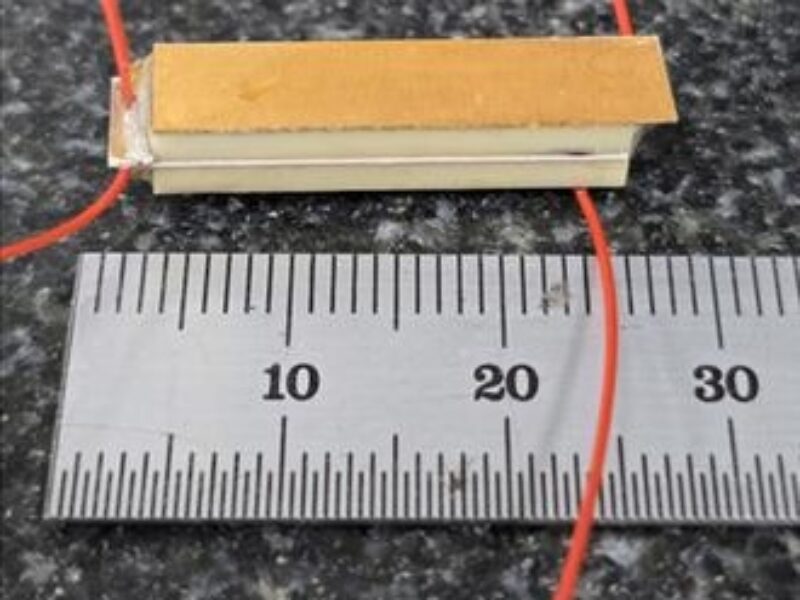
The receiver uses two piezoelectric layers that are stacked so that the front layer harvests incoming ultrasound energy to generate electricity, while the rear layer captures the residual ultrasound to produce additional power. By combining the output from both layers, the harvester achieves a power density of 497.47 mW/cm2 and a total power of 732.27 mW in water, which is over 20% greater efficiency compared to that of conventional designs.
Ultrasonic power harvester
The ultrasound transmitter was fabricated to generate an ultrasound beam with a main lobe width of 6.4 mm × 28 mm in elevational and lateral directions at a focal length of 30 mm. Based on this, the dimensions of the SW-PUSH were determined to be 6.4 mm × 23 mm × 4.6 mm.
These dimensions were specifically chosen to optimize energy harvesting efficiency by aligning the PUSH dimensions with the main lobe width of the ultrasound transmitter and the PZT-5H thickness was selected to be 2.0 mm to achieve an operating frequency of 1 MHz that was equal to that of the transmitter.
Each SW-PUSH unit was composed of two PUSHs made from PZT-5H in Korea, with a matching and separation layer made from an epoxy-glass mixture with a thickness of 300 μm. Both surfaces of the matching and separation layers were sputtered with Cr/Au (500 Å/2000 Å)) before being stacked onto each PZT-5H.
Using the harvester, the team demonstrated that a 140mAh commercial battery could be fully charged in just one hour and 40 minutes at an underwater distance of 30mm. In another experiment using 30mm-thick tissue, a 60mAh battery was fully charged within one hour and 20 minutes. This is at least twice the power output of previous technologies.
“This research effectively harvests ultrasound energy, which has not been fully utilized in the past, for wireless charging of implantable medical devices. We aim to commercialize a system capable of fully charging within one hour by combining this ultrasound-based wireless charging technology with high-efficiency semiconductor components,” said Professor Jinho Chang from the Department of Electrical Engineering and Computer Science who led the research.
 If you enjoyed this article, you will like the following ones: don't miss them by subscribing to :